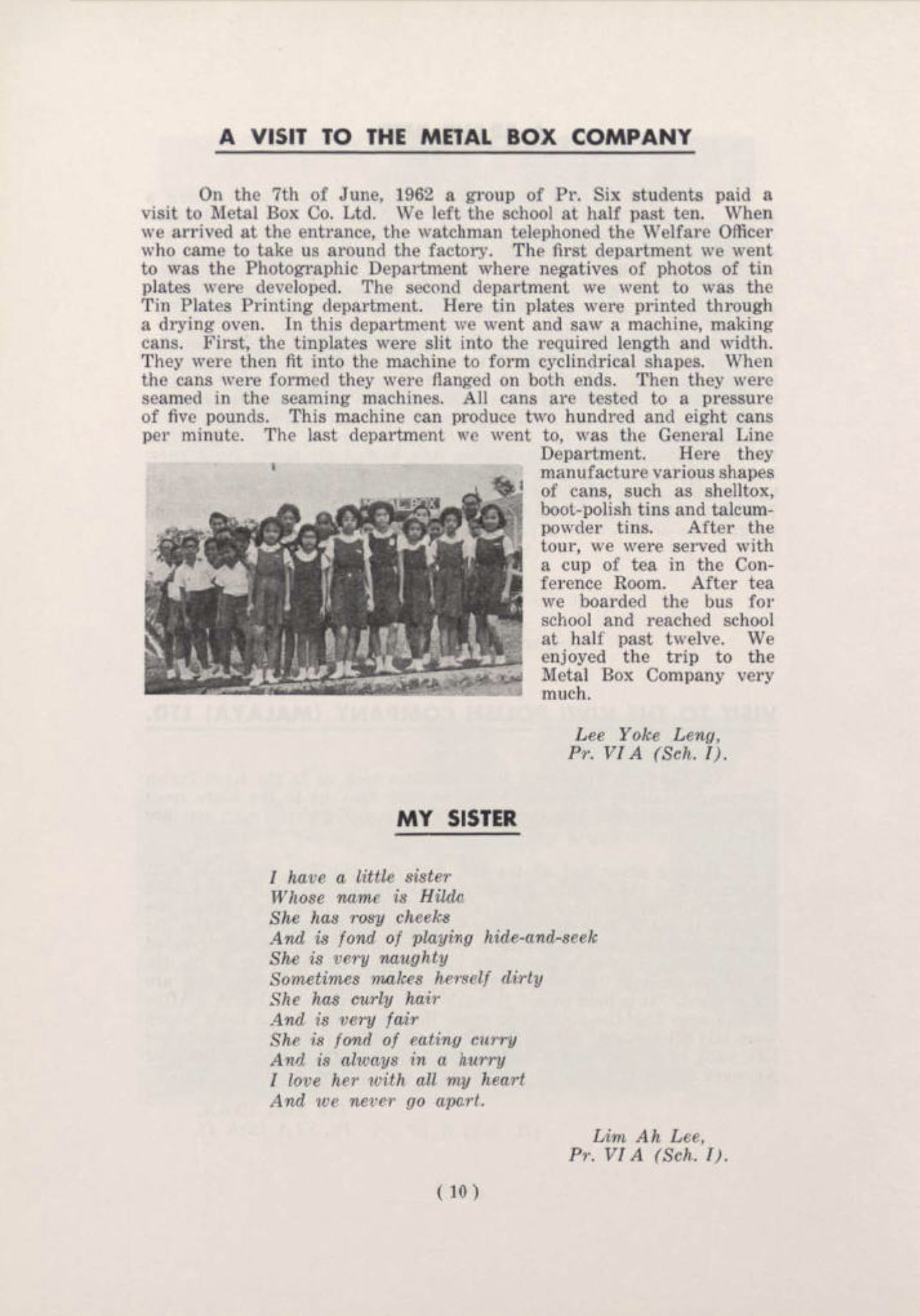
Back in 2012, I showed snippets of the first ever PEES school magazine Vol 1 No 1, issued in 1962. Back then, I was unable to obtain facsimiles of all the inside pages. (Link here:- School Magazine of 1962)
Finally, I can now show you the entire magazine. Should anyone of you can still remember or recall your memories from that time, I would love to hear from you. I really love the old adverts. I wonder how many of the advertisers are still around now? I had a really good laugh when, poignantly, I saw the last advert inside was from Singapore Casket!! ha ha. Leave your comments below and don't forget to include your name please. (It may take a while for all the pages to load!)
It has been too long since I last focused on this blog and for that I do apologise. These past months I have been busy with my video project which I had put off for quite a while as well, but decided that I should try and at least finish it before the end of this year. And this I must say I have accomplished.
Following my videos on the Japanese Invasion of Singapore during World War 2, where I covered the Battle of Chua Chu Kang, followed by the Massacre at Dairy Farm and lastly, the Battle of Bukit Batok, I have now completed my 4th video in the series and it is about the Battle of Bukit Timah.
This last video was so much tougher to do as it involved so many army units and each had to be mentioned as they all had a part to play in it. The research I had to do to look up each and every unit was what took the most time. This time I had the good fortune of getting more details from the Japanese side.
Most Singaporeans would have heard about the Battle of Bukit Timah but many do not know more than perhaps where it took place? Perhaps that is you too?
So as not to spoil anything further for you, I will not say any more but to ask you to enjoy my latest video on Youtube. But I do ask that you please leave a comment on the Youtube channel, and a 'Like' if you really liked the show. I am sure you will learn something from it.
(If you have problems with clicking on the image, you can click this link:- https://www.youtube.com/watch?v=_Hey-5_QO9M )
One of the earliest construction from the development of the Hillview area, and in fact, the last surviving original feature today is the Hillview Circus. The circus*, or more commonly called a roundabout today, was built in 1948 as part of the roadworks leading to the two pioneer post-war factories being built then at Hillview. *(Circus, from the latin circ, meaning circle and was typically termed in the British colonial days as traffic circus or traffic circle)
The two post-war factories were the Malayan Guttas Co Ltd and the National Carbon Co Ltd. Malayan Guttas produced the famous Wrigley Chewing Gum, while National Carbon manufactured the Eveready dry cell batteries. Both factories began construction in 1947 on land that were generously doled out to foreign corporations to help with the post-war economic recovery of Singapore.
This aerial photo taken on 15 April 1948 shows the construction in progress of the two factories and the building of Hillview Road and Hillview Avenue. The Hillview Circus was located at the junction of these two roads. The KTM Railway girder bridge was also constructed at the same time over Hillview Road. During the construction of this girder bridge, the railway line had to be temporarily diverted to allow for the construction of the bridge.
Creation of Hillview Road and Hillview Avenue to serve the two new factories of National Carbon and Malayan Guttas. A new girder bridge was required to support the KTM Railway line over the new Hillview Road. This original girder bridge was removed in Nov 2011.
The completed development of Hillview Avenue and Hillview Road in 1950.
During the construction of the factories, a temporary road track was created directly from Upper Bukit Timah Road into the construction sites. This track can be seen at the upper right corner and was the primary access way until Hillview Road, that connected Upper Bukit Timah Road, was completed. The above picture show both the completed railway girder bridge and Hillview Circus.
SAME, SAME BUT DIFFERENT
Hillview Circus in 1955. The bus attempting the incline at Hillview Road is Service No.5 of the Green Bus Co.
Hillview Circus in the year 2000. The HDB flats in the background formed the Hillview HDB Estate built in 1975. In 1999, HDB announced that Hillview Estate would be demolished under the SERS programme.
At one corner of Hillview Circus, there used to be the Castrol (Far East) Ltd, a British lubricant manufacturer with their first overseas plant located in Singapore in 1963. This lubricant maker sold the land that subsequently was bought by private condominium developers. The site is now occupied by the Glendale Park and Hillview Park condominium complexes.
Castrol Far East Ltd
Glendale Park Condominium
Changes are still ongoing around Hillview Circus. HillV2, a shopping mall, as well as the PA Bukit Batok Community Club now surrounds the other sides of Hillview Circus with a new road, Hillview Rise separating these complexes.
How much longer Hillview Circus will remain as it is is anyone's guess. In Singapore, roundabouts or circuses are now an anachronism in today's fast paced and high speed traffic. Most likely, we will see the circus replaced with a signalised traffic crossroad. Who knows?
TRIVIA: Did you know that Hillview Avenue was once used as Singapore's Grand Prix race track circuit in 1956 and 1957? Long before the Thomson Circuit or the Marina Bay F1 Circuit! Click on this link to read about the history of the Hillview Grand Prix circuit.
When I was preparing a sketch map for my previous post, I searched for one that would show the hills and relief of the area around Hillview. I found an old 1924 map and used that as an overlay for my sketch map about battles that occurred in the region of Hillview.
Most everyone, I am sure, would not have noticed something on the battle map unless you are into railways or perhaps tried to look for the Rail Corridor which, of course being 1924, would not be on the map. Was there something different about the railway line there?
While doing the sketch map, my mind too got distracted by the railway line and I was thinking that perhaps I could share some trivial information that I knew about the railway line here.
On the battle map, there is a railway line drawn from Bukit Timah Village running towards Bukit Panjang. This railway line was not the one that is today's Rail Corridor, the NParks project to conserve the former KTM railway corridor as a 'Green Corridor'. This rail line was the older and original Tank Road-Kranji Railway, or sometimes called the Singapore to Woodlands Railway.
I reproduced the map here and the Tank Road-Kranji Line is marked in RED
(Click on picture for detailed view)
The original Tank Road-Kranji Line that was laid in 1903 ran alongside Bukit Timah Road (from Newton) to Bukit Timah Village. From there, it curved back towards Upper Bukit Timah Road and continued northwards to Bukit Panjang Village, on the western side of the road.
In 1932, the Tank Road-Kranji Line was replaced by the new Keretapi Tanah Melayu (KTM) Railway (marked in BLUE in the map) that started from Tanjong Pagar instead. Now defunct since 2011, this is the current Rail Corridor.
In this region, the KTM Railway ran along the foothills of Bukit Timah Hill and crossed Upper Bukit Timah Road near Rail Mall, continuing north using the same track-bed as the older Kranji Line all the way to the Johore Causeway.
While this may be something that some of you already know, that there were two separate railways, there's more trivia about this section of the railway that will surprise most of you.
The proposed Hillview Line When the 1903 Tank Road-Kranji Line was being planned, the original route was proposed on the western side of Bukit Batok (hill). This would be through the valley between Bukit Batok and Bukit Gombak, in the region that would in future become 'Hillview'. The planned route is marked in YELLOW above.
However, this plan was rejected and the route was redesigned for the railway track to run along the eastern slope of Bukit Batok, running parallel to Upper Bukit Timah Road. You can see the abrupt change in the track direction after Bukit Timah Village. This diversion would be at Toh Tuck Road today, where the Bukit Timah Community Club is located.
Perhaps it was easier from an engineering or construction perspective to use the main road? I do not know the real reasons for this change in routing. I hope some railway expert can reveal the reasons by commenting in this blog?
Things might have been a lot different perhaps for Hillview had the railway line been built through it. Hillview Avenue, that was constructed in the 1970s, was laid on the exact route that the railway line would have taken.
The older 1903 Tank Rd-Kranji Railway ran on a terrace beside Upp Bt Timah Road. The newer 1932 KTM Railway was located on the other side of the road. The Ford and Hume factories were only built in 1941. The raised railway terrace can still be seen today.
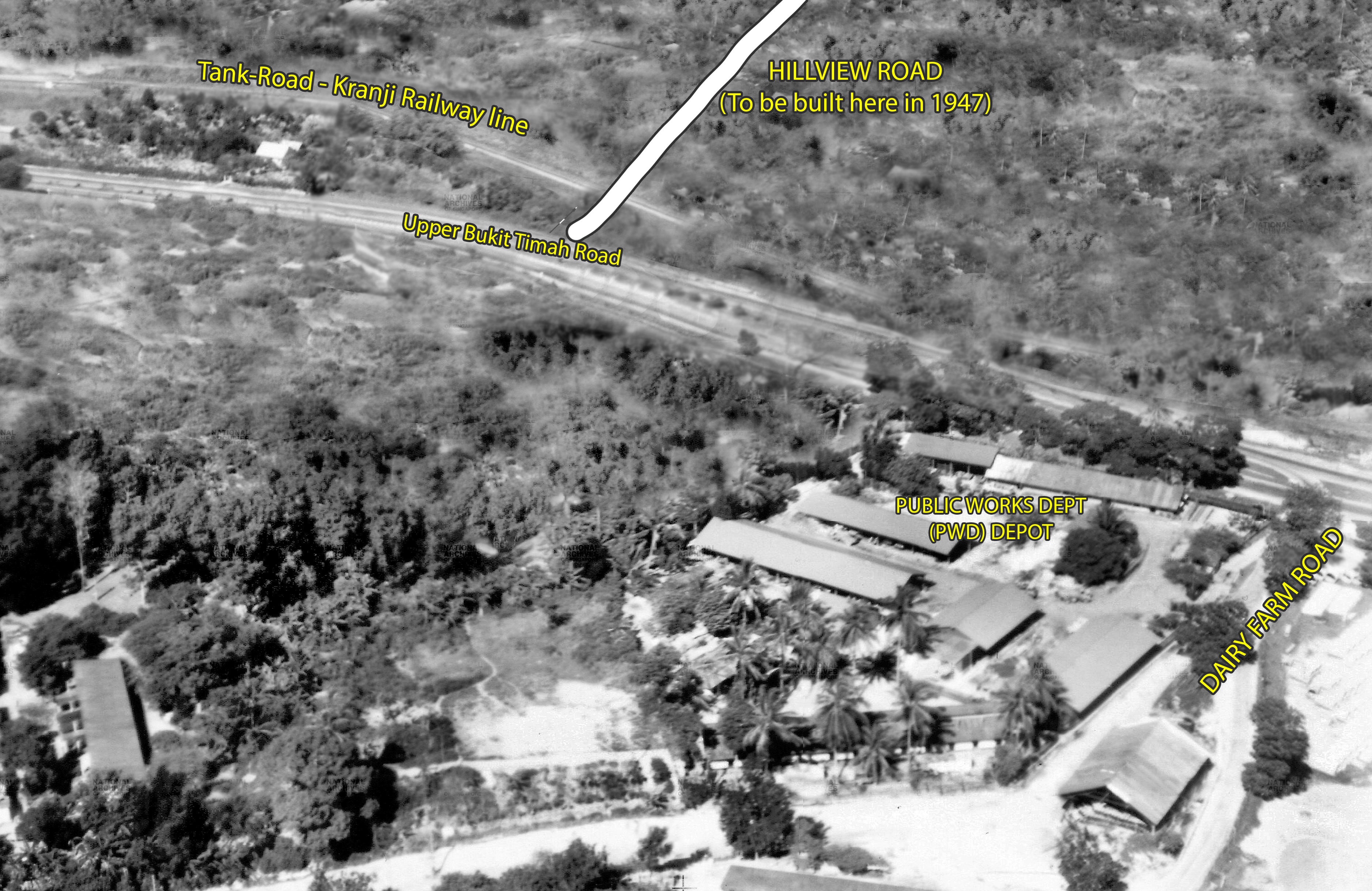
The Tank Rd-Kranji railway running down from the terrace. The future Hillview Road would be built here in 1947. The buildings at the bottom were the PWD Depot at Dairy Farm Road.
This is a map from 1898 of Singapore (from the YaleNUS/NLB collaboration online library) that depicts the original Kranji to Woodlands railway line drawn through the 'Hillview' region. The coloured overlay on the map was probably not on the original 1898 map but was likely drawn in at a later date but before the completion of the railway line.
When World War Two descended onto Singapore in early 1942, the area that was to become Hillview in the future was still 'undeveloped' in the sense that we understand development today.
Located in the valley between the ridges of Bukit Gombak and Bukit Batok, the hill slopes were then covered mainly by rubber plantations on the Gombak slopes, while on the Bukit Batok ridge were remnants of old pineapple farms and some older gambier farms that had existed since the 1840s. This 'Hillview' valley stretch all the way from Bukit Batok hill north to the plains in front of what is the Ministry of Defence installation today.
The only 'development' then in 1942 were the new factories of Ford Motors and the Hume Pipes Co., the more established Cold Storage Dairy Farm and the Nanyang Shoe factory at edge of Bukit Panjang Village. All these developments were along Upper Bukit Timah Road between the 8th & 10th milestones. Apart from these, it was mostly rubber plantations along the road.
It was an area that was still very ulu or rural, and at the periphery of the even more rural regions of Chua Chu Kang, Lim Chu Kang and Woodlands!
The invasion by the Japanese army towards Bukit Timah Village. 8-11 Feb 1942. (click on the map for a detailed view)
The Japanese Invasion On 8th February 1942, the Imperial Japanese Army invaded Singapore by crossing the Straits of Johore at the Sarimbun and Lim Chu Kang coast. Within the next 24 hours, the invading army had already conquered the entire Lim Chu Kang countryside and by afternoon the next day, 9th Feb, the British RAF Tengah airfield fell into their hands.
General Yamashita, the Japanese Army commander, who was nicknamed the Tiger of Malaya, had initially planned that the total conquest of Singapore would be completed by the 11th of Feb 1942. However, his supply line was stretched too thin in Malaya and his army was running low on supplies, including food, fuel and ammunition by the time they had arrived at the Straits of Johore bordering Singapore.
Thus, he changed his immediate objective to the capture of Bukit Timah by the 11th of Feb instead. Bukit Timah was where the British had their supplies, food stores and fuel depots and he coveted these supplies for his own men and army.
Bukit Timah was also the highest point in Singapore which would afford the invaders a good view of the entire battlefield. More importantly Bukit Timah was the major intersection where the main roads spread north, south and west of the island. Whoever controls the junction, controlled all movement to these areas.
With his objective set, his plan was to use two of his best army divisions, the 5th Division and and the 18th Division to capture Bukit Timah in a pincer movement. 5th Division would moved along Choa Chu Kang and turn south at Bukit Panjang and head towards Bukit Timah with the support of Japanese tanks. The 18th Division would move south-east through Bulim and along Jurong Road towards Bukit Timah Village, where they would converge with the 5th Division. Both Divisions were given only 48 hours to accomplish this task of capturing Bukit Timah Village.
(There was a third Japanese Army Division called the Konoye Imperial Guards, but this unit was given a secondary task of moving across the Mandai and Thomson areas and played a more diversionary role to the main attack.)
Bukit Panjang By the evening of the 10th Feb, the 5th Division had arrived at Bukit Panjang and was slowly maneuvering down towards Bukit Timah Village. They had fought and won fierce battles against the British at both Bulim Village and Keat Hong Village. By the time they arrived at Bukit Panjang, they also had the support of tanks which had been quickly pressed into service upon crossing the Straits of Johore.
At Bukit Panjang, the 5th Division was split into the three fighting regiments, the 11th, the 42nd and the 21st Infantry Regiments. The 11th Regiment mauraded through Bukit Panjang Village and followed the water pipeline towards Bukit Timah via Dairy Farm, while the 42nd Regiment accompanied and provided infantry support for the tanks going down Upper Bukit Timah Road.
The 21st Regiment took the path along the Malayan Railway line and moved into the Hillview valley. This last group was given the task of capturing both the Ford and Hume factories.
Jurong Over at the Jurong area, the 18th Division moved through the Bulim rubber plantations relatively easily till they came to Bukit Batok where they were met by the British Indian Army's 15th Infantry Brigade. With their superior numbers and battle-hardened tactics, the Japanese forces routed the British army brigade at Bukit Batok.
Capture of Bukit Timah
By the late morning of the 11th Feb, both Japanese 5th and 18th Division had overwhelmed the British defenders at Bukit Timah Village and secure the high point of Bukit Timah hill.
Surrender Following this victory, General Yamashita gave an ultimatum to the British to surrender. However, the war in Singapore continued until for a few more days until the British finally surrendered on the 15th Feb, the first day of the Chinese New Year in 1942. Three and half years of brutish Japanese Occupation was to follow for the citizens of Singapore.
For those who find this article TL;DR, I have actually done two videos on the same subject. You can watch the video on Youtube at these links:-
Since first writing about the infamous Hillview Mansion on Bukit Gombak in 2012, I've added about another half a dozen more articles related to it. The last two being exclusive exterior photos of the 'haunted' building photographed and shared here by my reader Lester Yeong.
(Links to these articles are at the end of the blog)
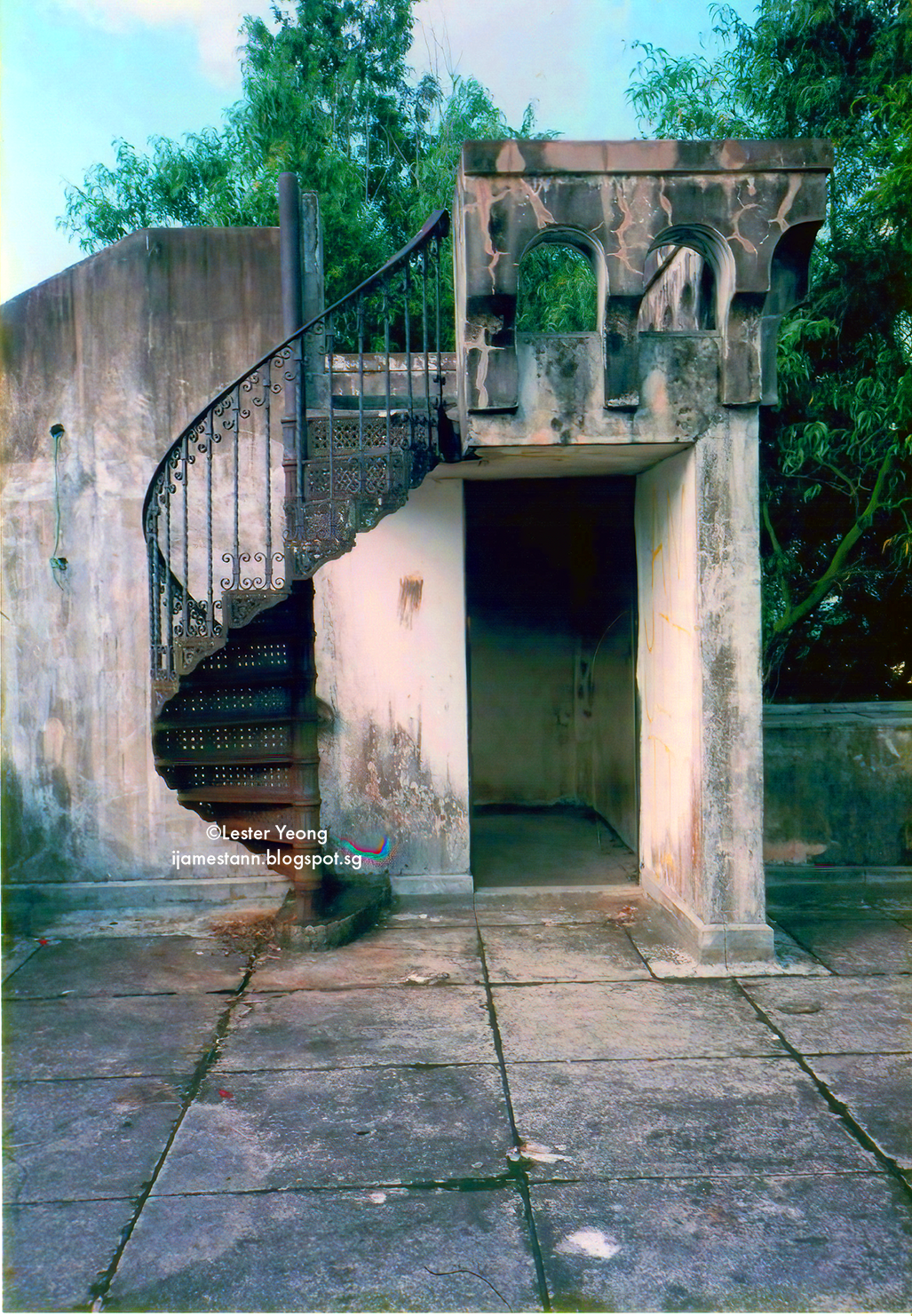
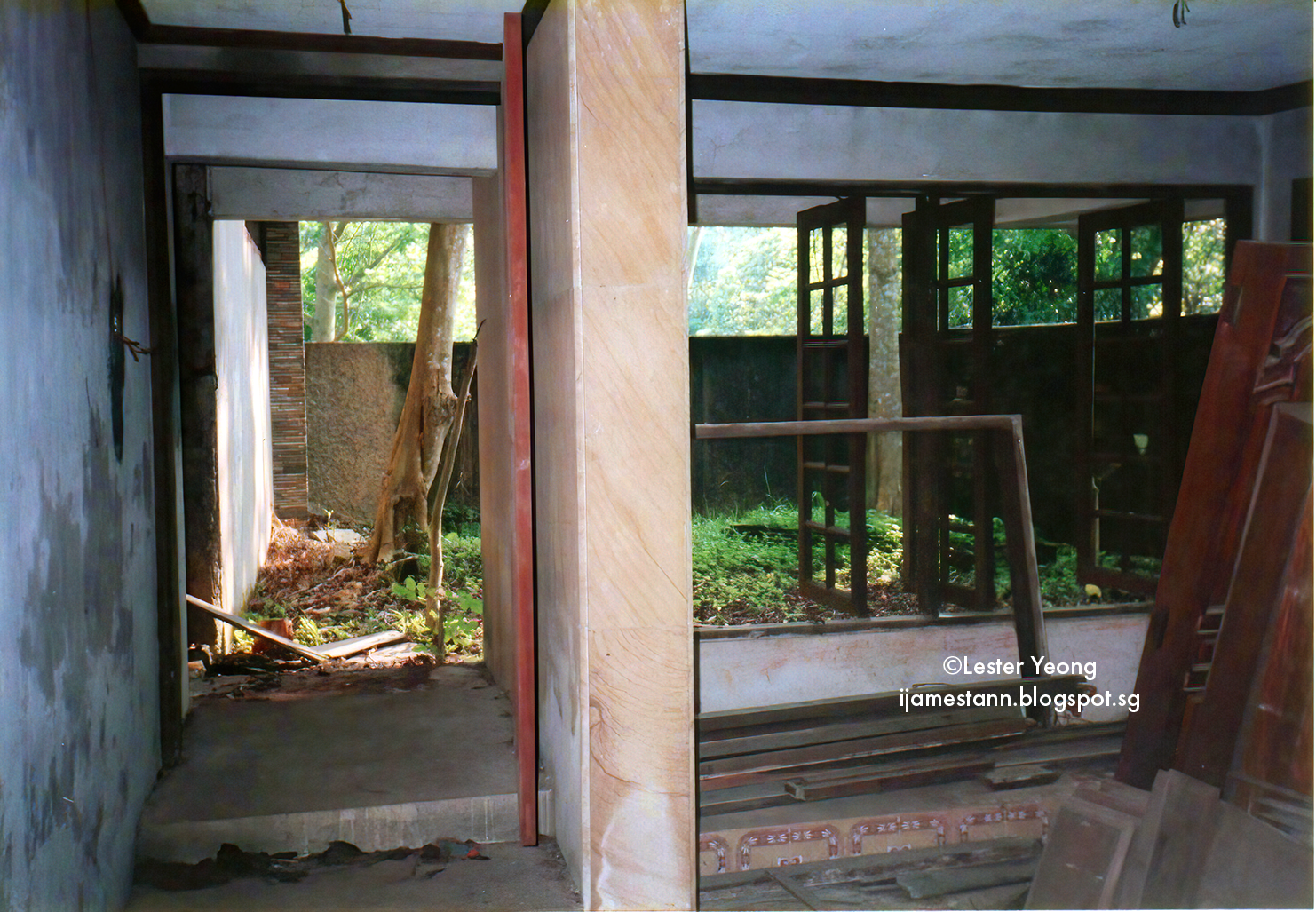
In this article, I will take you inside the Hillview Mansion to see the unfinished and abandoned interior. The dark, creepy and unkempt rooms with the incomplete construction works would definitely have made any brave intruder think the place was haunted. Evidence of the sudden abandonment were all over the scene. Of course, today the building no longer exist, being demolished long ago, with only the driveway retaining wall and the original gate remaining.
I am not too sure if the State has taken back the land but prominent "No trespassing" signs and even a Police notice were erected as a warning that people have been prosecuted for the offence. (Adventurers and hikers to Bukit Gombak please take note.)
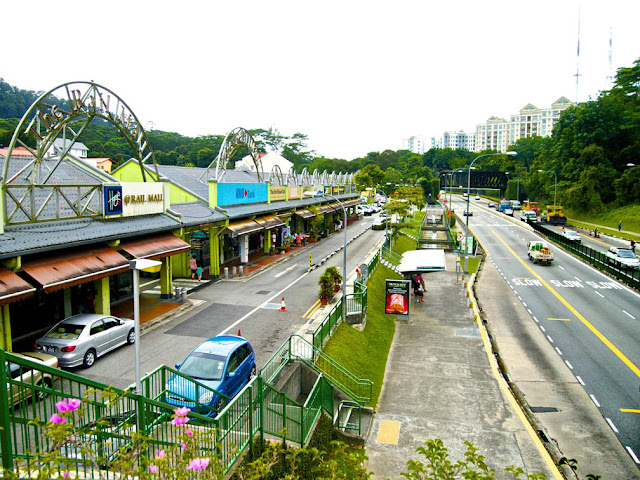
Unless you have been following my blog, or lived in the area in the past, you may not be aware that the Rail Mall at Upper Bukit Timah Road started off life as quarters for rubber plantation workers.
Rail Mall at Upper Bukit Timah.
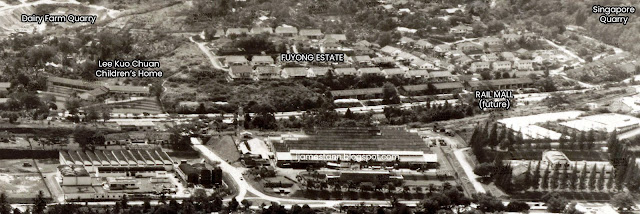
Philanthropist Lee Kong Chian owned the entire swathe of land on the eastern side of Upper Bukit Timah Road 14km (9-1/2ms) from the Singapore Quarry to the PWD Quarry at Dairy Farm.
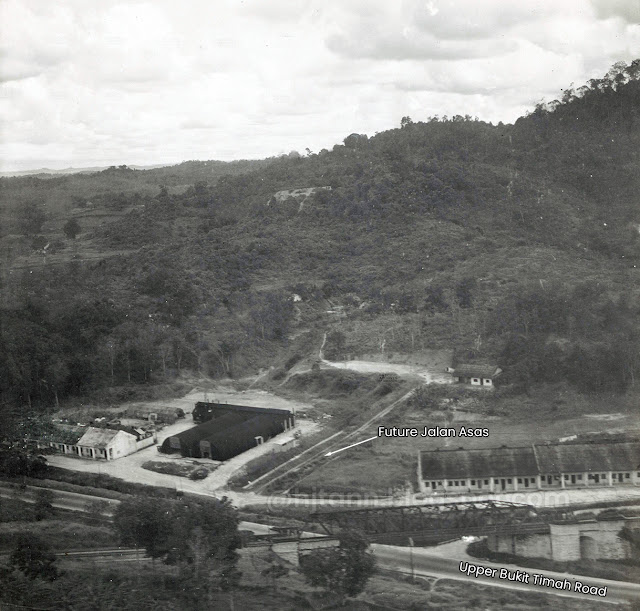
On this hillside, he planted rubber trees and the rubber estate became part of the Lee Rubber Plantation conglomerate. After World War II, in order to provide decent living quarters and accomodation for his plantation workers and their families, Lee Kong Chian, in 1947, built four rows of workmen houses called artisan quarters at the edge of his rubber plantation.
Each row had twelve units. Each unit had two small bedrooms and a small living room with an attached kitchen. At the rear of each unit there was a small open-air yard where a separate bucket system toilet was set apart away from the living space. At the beginning, there was no electricity and using kerosene lamps was the only way to get illumination at night. But back then, it would have been almost a luxury for manual workers, considering that most people were living in kampong attap houses. A real luxury was fresh water direct from the tap within their own household.
This was how it looked in 1947 when the worker's homes were built. You can see most of the hill slope at the back covered with rubber trees. Two rows of the terraced homes visible are separated by some buildings which may be part of the rubber plantation processing facility. If anyone knows what these buildings are, please drop me a comment below. The path beside the black building would be transformed into Jalan Asas in future. A prominent landmark here is the black truss bridge that carried the KTM Railway line and crossed Upper Bukit Timah Road here (bottom right).
In the 1950s, more of the rubber plantation was given up to build a private housing estate. This was Fuyong Estate, that was also developed by the Lee Foundation, comprising terraced, semi-detached and detached bungalow houses. The original four rows of workmen's quarters were then sold or rented out as there was no longer a need for plantation workers due to the fall in demand for natural rubber. These workman quarters were mostly converted into shophouses for various trades ranging from tailoring, provision shops to motor workshops and coffee shops.
Click on the picture for a detailed view.
This is an aerial view of the land owned by the Lee Foundation, between the Dairy Farm Quarry (left) to the Singapore Quarry (right.) The Lee Kuo Chuan Children's Home was built on land donated by Lee Kong Chian to the Salvation Army for them to run a Children's Orphanage.
In 1995, the 4 rows of shophouses were re-acquired by a Lee Foundation company called Pulau Properties, who then created the shopping arcade called Rail Mall. After 2018, it was sold to the SPH group.