Showing posts with label Rail Mall. Show all posts

Friday, August 19, 2022

Hillview Avenue was a proposed railway track !

When I was preparing a sketch map for my previous post, I searched for one that would show the hills and relief of the area around Hillview. I found an old 1924 map and used that as an overlay for my sketch map about battles that occurred in the region of Hillview.

Most everyone, I am sure, would not have noticed something on the battle map unless you are into railways or perhaps tried to look for the Rail Corridor which, of course being 1924, would not be on the map. Was there something different about the railway line there?

While doing the sketch map, my mind too got distracted by the railway line and I was thinking that perhaps I could share some trivial information that I knew about the railway line here.

On the battle map, there is a railway line drawn from Bukit Timah Village running towards Bukit Panjang.
This railway line was not the one that is today's Rail Corridor, the NParks project to conserve the former KTM railway corridor as a 'Green Corridor'.
This rail line was the older and original Tank Road-Kranji Railway, or sometimes called the Singapore to Woodlands Railway.

I reproduced the map here and the Tank Road-Kranji Line is marked in RED

(Click on picture for detailed view)


The original Tank Road-Kranji Line that was laid in 1903 ran alongside Bukit Timah Road (from Newton) to Bukit Timah Village. From there, it curved back towards Upper Bukit Timah Road and continued northwards to Bukit Panjang Village, on the western side of the road.

In 1932, the Tank Road-Kranji Line was replaced by the new Keretapi Tanah Melayu (KTM) Railway (marked in BLUE in the map) that started from Tanjong Pagar instead. Now defunct since 2011, this is the current Rail Corridor. 
In this region, the KTM Railway ran along the foothills of Bukit Timah Hill and crossed Upper Bukit Timah Road near Rail Mall, continuing north using the same track-bed as the older Kranji Line all the way to the Johore Causeway.

While this may be something that some of you already know, that there were two separate railways, there's more trivia about this section of the railway that will surprise most of you.

The proposed Hillview Line
When the 1903 Tank Road-Kranji Line was being planned, the original route was proposed on the western side of Bukit Batok (hill). This would be through the valley between Bukit Batok and Bukit Gombak, in the region that would in future become 'Hillview'. The planned route is marked in YELLOW above. 

However, this plan was rejected and the route was redesigned for the railway track to run along the eastern slope of Bukit Batok, running parallel to Upper Bukit Timah Road. 
You can see the abrupt change in the track direction after Bukit Timah Village. This diversion would be at Toh Tuck Road today, where the Bukit Timah Community Club is located.

Perhaps it was easier from an engineering or construction perspective to use the main road? 
I do not know the real reasons for this change in routing. I hope some railway expert can reveal the reasons by commenting in this blog?

Things might have been a lot different perhaps for Hillview had the railway line been built through it.
Hillview Avenue, that was constructed in the 1970s, was laid on the exact route that the railway line would have taken.


The older 1903 Tank Rd-Kranji Railway ran on a terrace beside Upp Bt Timah Road.
The newer 1932 KTM Railway was located on the other side of the road.
The Ford and Hume factories were only built in 1941.
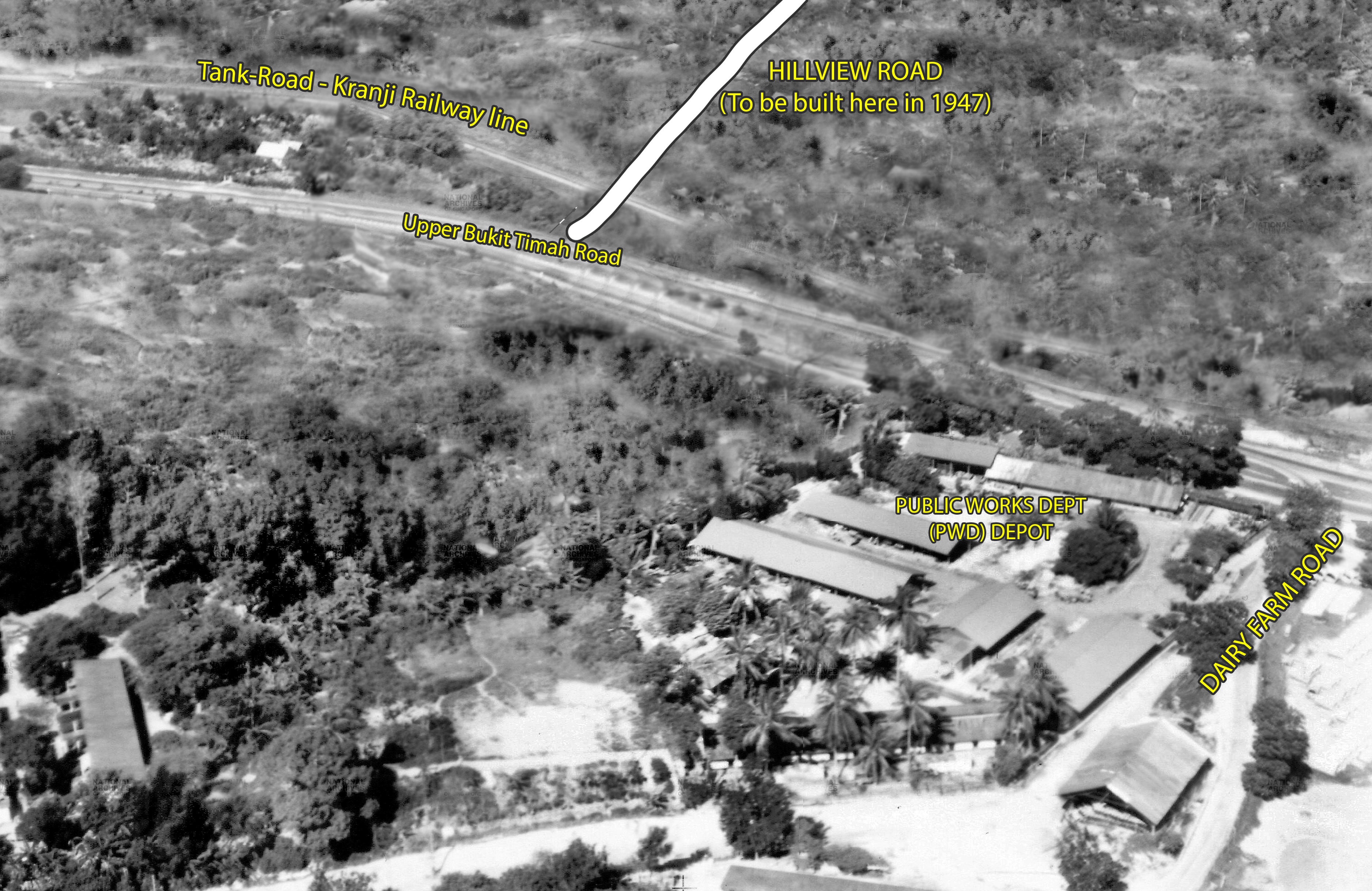
The raised railway terrace can still be seen today.


The Tank Rd-Kranji railway running down from the terrace.
The future Hillview Road would be built here in 1947.
The buildings at the bottom were the PWD Depot at Dairy Farm Road.


This is a map from 1898 of Singapore (from the YaleNUS/NLB collaboration online library)
that depicts the original Kranji to Woodlands railway line drawn through the 'Hillview' region.
The coloured overlay on the map was probably not on the original 1898 map
but was likely drawn in at a later date but before the completion of the railway line.


Thursday, February 17, 2022

The beginnings of Rail Mall & Fuyong Estate.

Unless you have been following my blog, or lived in the area in the past, you may not be aware that the Rail Mall at Upper Bukit Timah Road started off life as quarters for rubber plantation workers.

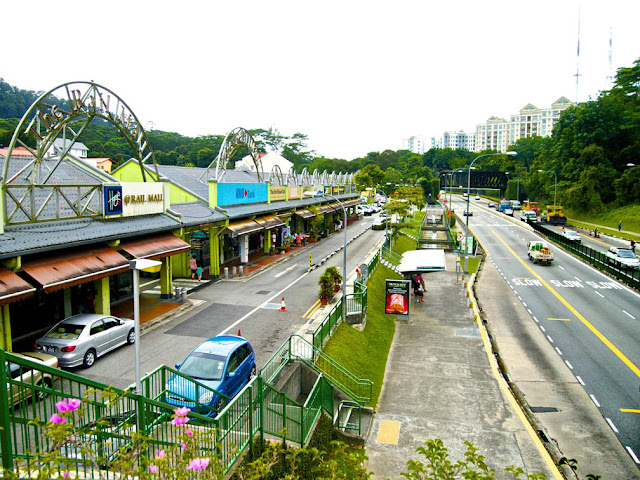
Rail Mall at Upper Bukit Timah.


Philanthropist Lee Kong Chian owned the entire swathe of land on the eastern side of Upper Bukit Timah Road 14km (9-1/2ms) from the Singapore Quarry to the PWD Quarry at Dairy Farm.

On this hillside, he planted rubber trees and the rubber estate became part of the Lee Rubber Plantation conglomerate.
After World War II, in order to provide decent living quarters and accomodation for his plantation workers and their families, Lee Kong Chian, in 1947, built four rows of workmen houses called artisan quarters at the edge of his rubber plantation. 

Each row had twelve units. Each unit had two small bedrooms and a small living room with an attached kitchen. At the rear of each unit there was a small open-air yard where a separate bucket system toilet was set apart away from the living space.
At the beginning, there was no electricity and using kerosene lamps was the only way to get illumination at night. But back then, it would have been almost a luxury for manual workers, considering that most people were living in kampong attap houses. A real luxury was fresh water direct from the tap within their own household.


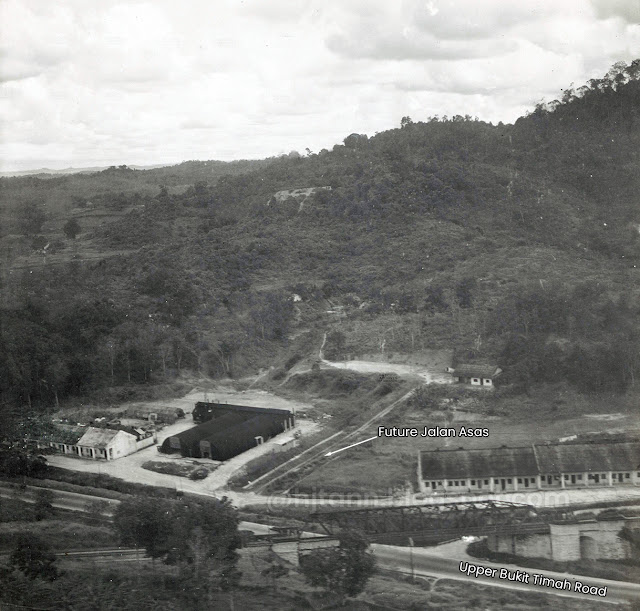
This was how it looked in 1947 when the worker's homes were built. You can see most of the hill slope at the back covered with rubber trees. Two rows of the terraced homes visible are separated by some buildings which may be part of the rubber plantation processing facility. If anyone knows what these buildings are, please drop me a comment below. The path beside the black building would be transformed into Jalan Asas in future. A prominent landmark here is the black truss bridge that carried the KTM Railway line and crossed Upper Bukit Timah Road here (bottom right).

In the 1950s, more of the rubber plantation was given up to build a private housing estate. This was Fuyong Estate, that was also developed by the Lee Foundation, comprising terraced, semi-detached and detached bungalow houses.
The original four rows of workmen's quarters were then sold or rented out as there was no longer a need for plantation workers due to the fall in demand for natural rubber. These workman quarters were mostly converted into shophouses for various trades ranging from tailoring, provision shops to motor workshops and coffee shops. 


Click on the picture for a detailed view.


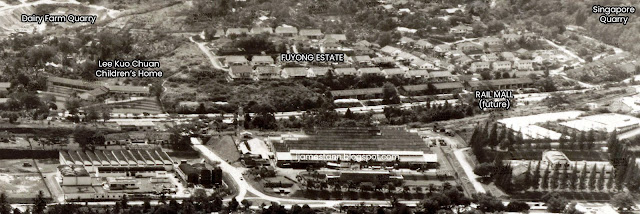
This is an aerial view of the land owned by the Lee Foundation, between the Dairy Farm Quarry (left) to the Singapore Quarry (right.)
The Lee Kuo Chuan Children's Home was built on land donated by Lee Kong Chian to the Salvation Army for them to run a Children's Orphanage. 

In 1995, the 4 rows of shophouses were re-acquired by a Lee Foundation company called Pulau Properties, who then created the shopping arcade called Rail Mall. After 2018, it was sold to the SPH group.


Related links:-
Fuyong Estate 
Chia Eng Say's Singapore Quarry
Dairy Farm
The Rail Mall

Monday, August 16, 2021

The Singapore Quarry and the Chia Eng Say connection.

This article was written back in July 2011 and I transferred it here from my other travel blog as some readers have been enquiring about the Singapore Quarry and rather than re-directing them away. Edited Aug 2021.

Strangely, small coincidences seem to keep popping up in sequence for me.
It all started with the KTM railway closure. (click on link to go there)
Visiting the Rail Mall led me to Fuyong Estate and to Jalan Asas.
This then led me onwards to the old shortcut to the Singapore Quarry Park.
At the quarry park there is a plaque that reads "A Quarry story of....Chia Eng Say..."

The plaque at the Singapore Quarry Park.

Click to read the Ode mentioning Chia Eng Say.

Then just last night, I chanced upon a blog by a Kevin Lee mentioning a disused 'nameless' road running by Rail Mall train tracks. He wondered why it was there.
Wow, just what are all these coincidences ?
I realised the common link to them all is Chia Eng Say!


The original Chia Eng Say Road ran beside the railway truss bridge.
Now abandoned and covered with detritus.

A brief background to the man, the road and the quarry

Chia Eng Say Road was a private road built by the quarry company for access to their quarrying operations. It was the only access from Upper Bukit Timah Road to the quarries and ran parallel to the former KTM railway line. I can still recall trucks with their load of huge granite rocks rumbling along the road, off to some construction site somewhere in developing Singapore.

The road ran through a Chinese kampong known to us 'locals' as Kampung Chia Eng Say.
The kampong has been demolished and the homesteaders have been resettled in HDB housing, I presume. How sad.

Two of my old schoolmates used to live in that kampong, Quek Chee Ling and Wong Bee Leng. Alas, I've completely lost contact with them after our school days ended.
I can recall visiting them often at the kampong, especially during the times when the Chinese wayangs played during some religious celebrations.
I used to lived at Fuyong Estate that was just beside the old quarry worker's kampung.

A footbridge ran from Chia Eng Say Road over the KTM railway line.
This gave the kampong folks and quarry workers direct access to Upper Bukit Timah Road.

The cul de sac at Jalan Asas. The playground on the right was where the old kampong was located.

The secret shortcut to the quarry at the end of the cul de sac.

Who was Chia Eng Say?
Mr Chia Eng Say was what we would call an entrepreneur today. A multi-millionaire businessman from Fujian, China, who established businesses in Penang and Singapore in the early 1900s.
He apparently lived in Katong with his large progeny, believed to be 7 sons and 15 daughters in all!  Old newspaper announcements of the past had several reports of his sons and daughters being married off with grand dinners held at his mansion at Katong.

The Chia Eng Say Quarries
Chia Eng Say obtained the rights to mining the granite on the mid-western area of the Bukit Timah Ridge in the 1930s. There he started quarrying operations at two separate but adjacent sites facing the 8-1/2 milestone Upper Bukit Timah Road. The two adjacent quarries eventually merged into a single quarry. They were initially known as the Chia Eng Say Quarries. 

How it became known as the Singapore Quarry was simply a matter of convenience.
Chia had set up several subsidiary companies to run his quarrying business.
The major company was called the Singapore Quarry Co Pte Ltd, and this was the firm that undertook the actual mining.
After Chia Eng Say died in 1943, the business was usually referred to as Singapore Quarry.
The name became pegged to the actual quarry site itself. Thus, the Chia Eng Say Quarries became simply known as the Singapore Quarry.
The quarry was closed when the Singapore government ordered all mainland quarrying of granite to cease in 1970.

The private road, Chia Eng Say Road, located beside the railway truss bridge, became disused over time and was later expunged.  In the 1980s, NParks recovered the land as part of the Bukit Timah Nature Reserve. The quarry was to be converted into a nature park.
A new access path to the nature park quarry was formed from disused sections of the old Chia Eng Say Road.
The old name of Chia Eng Say Quarry was then replaced officially as the Singapore Quarry Nature Park.

Kampung Chia Eng Say
Chia Eng Say also built homes for his workers nearby, using the unallocated land that was beside the quarry adjacent Fuyong Estate. These were basically squatter land with temporary occupation licences given to Chia's company. Thus, colloquially, the kampung came to be known as kampung Chia Eng Say.

Chia Eng Say's legacy lives on
Besides being mentioned in the ode on the plaque, his name is now firmly entrenched nearby.
When the old shophouses at Fuyong Estate were re-developed into the Rail Mall, the little service access road in front of the shops was widened to a 2-lane road and the name Chia Eng Say Road was transferred to this upgraded stretch of road.

Trivia: In 1937, Chia Eng Say won the tender to supply all the granite to build the (old) Supreme Court building. The stones came from this quarry.


The service road in front of Rail Mall is now named after Chia Eng Say.


Below is an overhead aerial view of the Singapore Quarry
with the defunct Chia Eng Say Road leading up to it.


Thursday, August 20, 2020

The Railway lines at Hillview

In my previous article that I posted in July regarding the Hillview factories along Upper Bukit Timah Road, a lot of interest was centred on the two railway lines that ran past Hillview. These were, firstly, the 1903 Singapore-Kranji Railway, and secondly, the 1932 KTM Railway that 'replaced' the 1903 railway line. I must clarify that even though I occasionally write about the railways, I am not a rail enthusiast, nor an expert on this subject, and my writings about them only relate to my blog articles here.

One of my contacts, a local railway expert, Trevor Sharot, had earlier re-discovered and confirmed the existence of a tunnel that was seen in old 1950 aerial photo maps. This tunnel is under the now 'Green Corridor' and is not clearly visible by any and all who trek along this conservation corridor. It is covered by shrubs and overgrowth. I have marked it out in this 1950 aerial photo. I will do a writeup on this tunnel in a future blog article.


The hidden tunnel under the old 1932 railway track.


Another old friend and railway enthusiast, Peter Chan, also got in touch with regards to the older 1903 Singapore-Kranji Railway. Peter's grandparents lived at the Chestnut area and had seen the building of the 1932 KTM railway that was to replace the 1903 Singapore-Kranji Railway.
More fortuitously, Peter's grandfather had the presence of mind to take photos of the construction in those days, and Peter shared one with me.


What is interesting about the black & white 1931 photo is that it shows the steel truss bridge being built across Upper Bukit Timah Road in 1931 for the new KTM Railway that would run to Tanjong Pagar. This now retired truss bridge is being conserved today as a heritage item along with the rail corridor.

What is of greater interest in this B&W photo (especially to rail enthusiasts) is that you can see behind the bridge, the level on the hillside where the older 1903 Singapore-Kranji Railway line ran down from the hill (where Ford Motors would later be built). It was on a higher level above Bukit Timah Road.

With Peter's permission, I enhanced the old B&W photo and found that I could then make out the old telegraph poles that ran alongside the 1903 Kranji railway tracks! The old telegraph poles were significant in determining the layout and alignment of the 1903 tracks as seen in my previous posted article. (The red line).
In the old days, telegraph poles were built parallel alongside the railway lines.

 Note the 1903 telegraph wires up on the bridge level (right of pic).
There also appears to be overhead electrical cables alongside Bukit Timah Road as well. These can be seen beneath and beyond the bridge.


Peter then sent me more photos he had!
These were the actual remnants of the telegraph poles which he found and had kept!


Parts of the 1903 telegraph poles.

Insulator
The telegraph wire insulator.
(Peter's souvenir from 1903)


Monday, February 11, 2013

Places around P.E.E. (10) - Fuyong Estate.

Recently, one of my blog readers emailed me after coming across my Rail Mall article.
She wanted to know if I had any old photos of Fuyong Estate where Rail Mall is located and where she is presently living.

My biggest surprise when I replied to her was when I realised that she lives in the house that is next to the one where I used to live. She would have been my immediate neighbour had I not moved away! But then, that was years ago, while she just moved in recently. She loves the ambience of the small estate but unfortunately is having some issue with soil movements, perhaps due to the underground MRT tunnels being dug beneath or from some other causes.

She was hoping I might have some photos of the area behind Rail Mall which borders her house.
If you have been to Rail Mall, you would know that there is a service road that runs behind Rail Mall. The road divides the estate from the shopping arcade.

I told her that during my time at Fuyong Estate, there was no road behind those rows of shophouses that would later be converted to become Rail Mall. There was only a footpath wide enough for, believe it or not, the night soil carrier to perform his cleaning operations each day. The service road was created to serve Rail Mall in recent years.

Fuyong Estate was built in the 1950s starting with the row of Worker's Houses fronting Upper Bukit Timah Road.
Being the nearest private housing development to Princess Elizabeth Estate, it was seen as the upmarket neighbourhood to aspire to. It comprised single-storied bungalows, semi-detached houses, a few rows of terrace houses and some doubled-storied semi-detached units. In all, about a hundred houses in the estate.
These were served by several shophouses consisting of provision shops, laundry, hairdressers, charcoal shops, and other sundry shops. These all fronted Upper Bukit Timah Road. The shophouses were converted to Rail Mall in 1995.

Heritage photos of Fuyong Estate taken in the late 1970s. 
(From National Library Board's PICAS database)

Fuyong Estate was built by the philanthropist Mr Lee Kong Chian in the mid 1950s. Lee Kong Chian also donated the adjacent land at Fuyong Estate to the Salvation Army for building a children's home called the Lee Kuo Chuan Home for Children. Today this has become the Salvation Army Paisehaven Nursing Home.
The roads within Fuyong Estate are known as Jalan Asas meaning Fundamentals, Jalan Tumpu (Focus), Jalan Siap (Preparedness), Jalan Tekad (Strength and Willpower) & Jalan Uji (Challenge or Test).

When my parents moved from Princess Elizabeth Estate to Fuyong, I was really happy because I had an entire bedroom for myself. This was not possible in our previous small S.I.T. flat. I also vaguely remembered that the house was priced about $7K at that time. Even then this was a princely sum. Recently I read that houses there now sold for over $1m! Maybe we shouldn't have moved away that soon?


The KTM railway bridge is located beside Chua Eng Say Road beside Fuyong Estate.

There were also 2 kampongs that grew as an annex to the estate. One was a Malay kampong at Lorong Chamar that was built behind Fuyong on the higher elevation of the hill slopes. The other was a Chinese village that was known as Kampong Chia Eng Say. This was located between Fuyong and the Singapore Granite Quarry. Both these kampongs were demolished and the squatters re-settled by the government years ago.

An old Chinese kampong house at Chia Eng Say Road.

  Recent photos of Fuyong Estate


Saturday, January 5, 2013

Places around P.E.E. (9) - Rail Mall

I was wondering if I should be writing a blog article on Rail Mall?
The simple reason was that Rail Mall didn't exist when Princess Elizabeth Estate was still around and vice versa. But I decided I might as well as some of you may not have been there since moving away from Princess Elizabeth.

Rail Mall is a misnomer. It is not a mall, more of an arcade and comprise shops along 3 rows of converted old style shophouses. It fronts Upper Bukit Timah Road between the old KTM Railway truss bridge (hence its name) and the Praisehaven Salvation Army opposite Hillview Road.


The majority of the shops there are eateries. Some of which are quite familiar such as Eat, Subway, Harry's and Coffee Bean & Tea Leaves. There are also shops like Cold Storage Supermarket, Watson's, RHB Bank and a few specialty service shops.

It is a regular haunt for residents who live around the Hillview condo belt and as yet is uncrowded and has a laid back atmosphere that attracts the young and trendy. It is also a welcome waypoint for trekkers to and from the Dairy Farm Nature Park and Bukit Timah Nature Reserve, located at opposite ends of Rail Mall.


BBQ Gangnam Style !


The old shophouses were actually part of the housing development called Fuyong Estate that is located behind Rail Mall. In fact, I lived at Fuyong Estate for about a decade in the 70s and can still remember the old run-down shops. Fuyong Estate used to house many of the British Forces staff. As such, the old shops catered mainly to them as they were quite isolated.
I can clearly remember the Chinese sundry shop (now occupied by Coffee Bean) that stocked mainly British provisions. I used to buy canned Irish Stew, which almost became a staple for my lunch! There were hardly any fast food for schoolboys those days!

The old shophouses around 1970. These were beside the old Chia Eng Say Road.
The same row of shophouses after conversion into Rail Mall.


The shophouses as it were in 1992. Some units were used as warehouses and storage.
There was a provision shop, a Chinese laundry, a hairdresser, a medical store and even a tyre repair shop then.

The same shophouses after the 1995 conversion as Rail Mall.

For those who remember the area before Rail Mall. Across the road were squatters on the KTM Railway land.
These included a lumber yard and an aquarium shop.


Here's a well kept secret. There's a nice quiet park just beyond Rail Mall.
Perfect for that evening walk or picnics. There's a shortcut to the Singapore Quarry Park nearby too.


Related links:
Fuyong Estate
Dairy Farm Nature Park
KTM Railway bridge
Singapore Quarry Park