
The industrialisation and gentrification of Hillview
 | |
|
In 1948, the British Government created a new statutory board called the Colonial Development Corporation (CDC). Its task was to promote and assist economic development of the post-war British colonies worldwide, especially in S.E.Asia and Africa. In S.E. Asia, it determined that the then Malaya and Borneo would have agriculture as its basis for their economy, while Singapore would pursue an industrialisation program.
In 1951, they proposed the construction of two industrial zones. One at the Redhill area and the other at Hillview, Bukit Timah. These would become known as the Colonial Industrial Estates.
The Colonial Industrial Estate at Bukit Timah
At Hillview, the CDC secured 53 acres of land and set about clearing the "gambia forest ", at an eyebrow-raising cost of £500,000, to prepare the land for new factories under their industrialisation programme.
Their plan was to raise twenty-two plots on which they would construct prefabricated factories. Each plot would be about 2 acres and businesses could apply to buy these pre-built factories on hire purchase, or seek favourable loans from the corporation to build their own factory. The land could be on long-term lease or bought freehold. The CDC would even provide loans to kick start their operations.
 |
| The Hillview Colonial Industrial Estate (in green) as proposed by the CDC. Hillview Avenue was extended for a further 1/2 mile (about a kilometre) |
Initially, the CDC managed to secure six enterprises to begin operations at the fledgling estate.
These were:-
1. Malayan Textile Mills, to produce cotton yarn,
2. Central Oil Refinery, to produce cooking oil, soap and margarine from palm oil,
3. Kiwi Polish Co, to produce shoe polishes and waxes,
4. Hong Kong Rope Manufacturing Co, to produce manila ropes.
5. Siglap Development Co, to produce edible oils,
6. Davar Company, to produce ceramic tiles and building material.
The first four companies began production in 1953 & 1954. However, the Siglap Development Co and the Davar Company failed to start and rescinded their contracts with the CDC.
In 1954, the CDC changed tack. After failing to lure more overseas buyers, it decided to offer the factories to local businesses to shift their operation from overcrowded Geylang, Kallang and Lavender to the new industrial estate. Despite generous incentives, there were no takers. It was, in a great part, due to social issues at the time, a mistrust of the British government corporation with its stringent and rigid rules, and that Hillview was so remotely located.
The project was floundering by 1958. The colonial's plan of economics by committee had fallen flat on its face. Only one more company was convinced to set up a business there. In November 1958, the F. E. Zuellig (M) Ltd company bought 5 acres to set up an animal feed mill. Only these five companies were ever located at the Colonial Industrial Estate.
Notwithstanding the slow progress of the industrial venture, the Chartered Bank was convinced to build a branch office at Hillview. It opened in April 1957 and would serve the industries and businesses in the rural area of Upper Bukit Timah, Bukit Panjang and Woodlands. It would go down in history as Singapore's most held-up bank. It was robbed at gunpoint in 1964, 1974 and again in 1980.
 |
| The Colonial Industrial Estate at Bukit Timah in 1958. Only the 4 original factories, plus one, were operating. (Click for detailed view. Photo source: National Archives Singapore) |
The late 1950s and early 60s were tumultuous times, with social and labour problems rampant in Singapore. Wildcat strikes at the slightest instigation were held. Workers from the Hillview factories including Ford Motors, Hume Industries, Malayan Guttas and Hong Kong Rope Co all participated in some form of industrial action during these times.
 |
| Workers on strike at the Ford Motors company. |
In May 1959, Singapore obtained full internal self-government from Britain. Singapore now had to manage on their own. This included the problems of high unemployment, lack of housing and education for the people.
The new government initiated bold plans to solve these issues. Until then, Singapore depended heavily on entrepot trading. The new focus was now on industrialisation and labour-intensive industries. Foreign investments were lured with 'pioneer' status, tax holidays and generous grants and incentives. The push was for more factories and more jobs for the population and providing technical training to work in these new industries.
Key to this was the creation of Jurong Industrial Estate in 1961 to spearhead the industrialisation programme. Building new factories, creating jobs and opportunities were urgent and crucial for survival. When Singapore became an independent nation in 1965, these issues became even more critical.
Re-vitalisation of Hillview 1961 to 1994
In 1965, the Economic Development Board, tasked to lead Singapore's economic development, identified and designated Hillview as a Light Industries Zone to provide secondary support to the heavy industries in Jurong. Hillview was given a new lease of life! It would be known as the Hillview Industrial Estate.
Land at Hillview was doled out generously for startups and a flourish of new industrial buildings came on-stream from 1965 onwards. New set-ups at Hillview included big names like Cycle and Carriage which set up a factory to assemble Mercedes Benz cars, Daihatsu and Isuzu trucks, Supreme Star Ltd built buses for SBS, Cerebos with their famous Brands Essence of chicken. Others were Lam Soon Oil and Soap Manufacturing, Metal Containers, Camel Paint, Yakult, Sanden Air Conditioners, Cement Aids, Singapore Ceramics, Sin Heng Chan Animal Feedmill and other SMEs. Even MacDonalds had their warehouse there when it opened for business in Singapore. Warehouse complexes like Kewalram Hillview, Hillview Warehouse and Lam Soon Industrial Building which could house up to 154 businesses, all came aboard with the growing Singapore economy over the next few decades.
A new road, Hillview Terrace, was created in 1972 leading to a sector of Hillview Avenue where a few rows of small terrace factories were set up. These terrace factories are still in operation today.
 |
| The Lam Soon Industrial Building, a warehousing office complex that could house up to 150 businesses. |
Of the colonial era factories, Hong Rope Manufacturing folded and the land was sold in 1963 to Castrol (Far East) Ltd to build a lubricant manufacturing facility. Malayan Textile Ltd was bought over by a new company called International Spinning Mills which took over their operations. The government by then had re-acquired all the land under the old Colonial Development Corporation.
With the growing Hillview Industrial Estate now on-stream and doing well, Hillview Avenue, which was then still a cul-de-sac, was extended in 1969 all the way south to join Jalan Perang, which was connected to Jurong Road. Jurong Road by then had been upgraded to a major highway leading to the Jurong Industrial Estate. Hillview Avenue was to provide an important bypass for traffic from Bukit Timah to Jurong.
(Link to article on the development of Hillview Avenue here)

The Hillview Industrial Estate, as it was now known, provided jobs and opportunities for many living in and beyond the area. Hillview was no longer seen as an 'ulu' backwater area.
The end of Hillview Industrial Estate
However, in 1994, the businesses there were all given a big surprise when it was suddenly announced that the entire Hillview Industrial Estate would be re-zoned as 'Residential Area' under the next Singapore Master Plan.
The area would be re-designated for high-end residential housing meaning it would be re-developed for condominiums and private landed properties. All the companies operating there were given notice to sell or move their operations, preferentially to the Jurong Industrial Estate. They were given a time frame up to 20 years to relocate.
A new phase of development once again was upon Hillview.
The gentrification of Hillview
 |
| Princess Elizabeth Park Estate. The artisan quarters (foreground) with the SIT flats built on the slope of Bukit Gombak (rear). |
However, it was still viewed with envy by many for its then modern facilities. It had its own sewage treatment plant which meant all homes had toilets that flushed! This was remarkable then given that most public housing were still using the 'bucket system'. It had running water and electricity supply to every unit. The things which we take for granted today was but a luxury for many then. There was a direct bus service to the city.
They had a regulation-size football field, albeit, of the smallest allowed dimensions, that was the central meeting place for residents in the evenings to watch soccer matches that were held regularly by both the residents and the nearby factory teams. There was a primary school within the estate for the resident's children education.
A community centre was organised and ran by residents. This was long before the Singapore government built community centres of their own. The initial centre was a small shophouse at Clarence Walk but it later moved to a larger shophouse at Prince Charles Rise where it could organise kindergarten classes for children in the estate.
 |
| The P.E.E. Kindergarten at Prince Charles Rise, 1959. |
In 1963, the government took over the management and building of all new community centres and a new community centre was built in 1963 for the residents. The community centre then came under the management of the People's Association with full time staff and resident volunteers to assist.
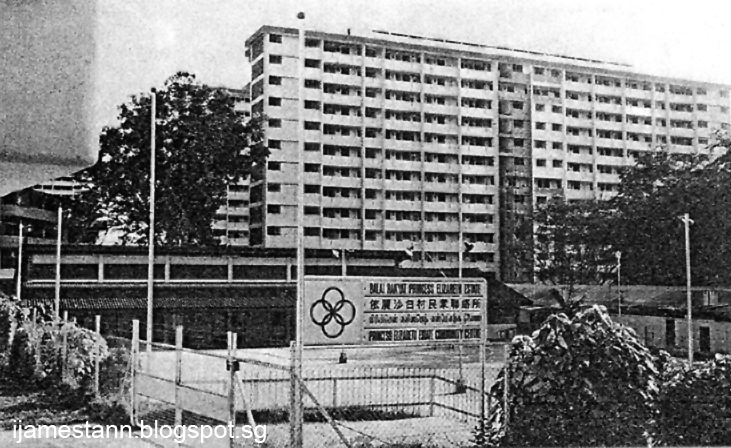 |
| The new People's Association Community Centre at Princess Elizabeth Estate. |
Despite being built in the 1950s, Princess Elizabeth Estate suffered from the lack of a produce market. Hawker pitches were ad-hoc and illegal. It was not till 1967 when a proper market was built. It was an experimental market by the HDB to combine a dry provision and wet market in one location and housing the hawkers in individual stalls.
 |
| The Princess Elizabeth Estate market 1967. |
In the late 1960s & 70s, Princess Elizabeth Estate gained fame and some notoriety.
The estate was well-known as the birthplace of many local musicians and bands. These included the Pests Infested, The Blue Stars and The Jumping Jades. Musicians like Ramli Sarip (Sweet Charity) and Moliano (Lovehunter) would all have their start connected with Princess Elizabeth Estate.
A dark side to the estate was that in the 70s, it was a haven for drug abusers and was raided constantly by the Central Narcotics Bureau.
Private housing developments at Hillview
In the early 60s, the former gambier plantation land beside Princess Elizabeth Estate was bought by housing developers, Malaysia Land Investments Ltd and Singapore Trading Co Ltd, for the construction of terrace houses.
Singapore Trading Co. built about 300 units of single storey and two-storey units. They called the new development Popular Estate.
 |
| Advertisement for the sale of homes at Popular Estate. |
In creating Popular Estate, six new roads were constructed at Hillview.
These were Jalan Dermawan, Jalan Zamrud, Jalan Intan, Jalan Gumilang, Jalan Remaja and Jalan Batu Nilam. The first residents moved in around 1965.
These were Jalan Dermawan, Jalan Zamrud, Jalan Intan, Jalan Gumilang, Jalan Remaja and Jalan Batu Nilam. The first residents moved in around 1965.
 |
| Popular Estate, fronting Elizabeth Drive. picture taken 2019. Most of the homes have been rebuilt and renovated over the years and hardly bears any resemblance to the original houses. |
By 1968, the second private development called Bamboo Grove Park was ready for occupancy. Similar to the private landed properties of adjacent Popular Estate, Bamboo Grove Park comprised terraced, semi-detached and bungalow homes. New roads built to access the homes were Chu Lin Street and Chu Yen Street.
In the early days of their residency, owners of these houses were faced with many teething problems. From mud slides from the 'never-ending' house building, low water pressure to houses uphill, to a lack of bus services. Worse for early residents was the fact that it was located beside an industrial area.
Air and noise pollution were the greatest gripes. Residents along Jalan Batu Nilam were breathing the constant fumes and pungent smell of cooking oil from Central Oil Refinery. Residents at Bamboo Grove were faced with the incessant pounding of metal from the adjacent metal works and the dust from the ceramics tile factories! The residents were even bombarded by flying granite shrapnels that flew into their houses on many occasions from the granite quarries at Bukit Gombak.
 |
| Landslide at Jalan Dermawan, 2007. |
Over the years since, more houses were built beyond Popular Estate and Bamboo Grove Park, called Hillview Gardens Estate. Today, it is generally accepted that the entire landed property area is colloquially called 'Hillview Estate'.
 |
| Jalan Remaja, separating Bamboo Grove Park from Popular Estate. |
Another Hillview Estate?
In 1975, the Housing and Development Board (HDB) announced the building of a new 'Bukit Batok Estate' as an extension to Princess Elizabeth Estate. Ten slab-blocks of the standard HDB design and three point-blocks would be ready by 1978.
The new estate would be named Hillview Estate and would include a wet market, a hawker centre, 33 shophouses and 4 coffeeshop eating houses. It will also have a new community centre.
The new estate would be built north of Princess Elizabeth Estate on land occupied by a Chinese kampong, opposite the Castrol factory. The kampong folks were most unhappy over the acquisition of their homestead but were crushed to learn that they were squatting on state land all the while. However, the kampong folks were given compensation and relocated amicably.
 |
| The Chinese kampong being demolished to make way for the HDB Hillview Estate. |
 |
| The HDB Hillview Estate in 1978. |
 |
| The new People's Association Community Centre at Hillview. It was later renamed Bukit Gombak Community Centre. It would be the 4th iteration of a community centre at Hillview. |
With the building of HDB Hillview Estate and the HDB new policy of home ownership, residents of Princess Elizabeth Estate were encouraged to buy a flat at the new estate. It was announced that no further development would be made at Princess Elizabeth Estate and empty flats would be mothballed to discourage rentals. The old Princess Elizabeth Estate Community Centre would be shut down. Princess Elizabeth Estate would face a slow run down until 1985, when all its residents who still remained were offered new flats at Bukit Gombak New Town.
Princess Elizabeth Estate School shifted to a brand new building at Bukit Batok New Town in 1986. The old school building was retained and converted into a facility for the disabled, the Red Cross Home for the Disabled. It was later sold to the United Medicare Centre and converted into a nursing home. Princess Elizabeth Estate, the gift to the royal couple, was finally demolished in 1985.
 |
| The old Princess Elizabeth Estate School 1955-1986. Revived as the Red Cross Home for the Disabled. In 2010 became the United Medicare Centre nursing home. |
The HDB Hillview Estate itself would come to grief in 1999 when it would come under the HDB Selective En Bloc Relocation Scheme (SERS). The entire estate was to be demolished and residents would be offered new flats at Bukit Batok Ave 5.
 |
| The demolition of Hillview HDB Estate under the SERS programme. |
 |
| The Hillview field where once Princess Elizabeth Estate and Hillview HDB Estate were sited. The row of trees in the middle marked the separation of the two estates. The field has been left to fallow for the past two decades. |
The coming of the Condos
With the re-designation of Hillview into a residential zone in 1994, companies located there started to shift their operations out, with most selling their land to housing developers.
But even before this had occurred, some companies, prior to the re-designation of 1994, had already decided to close their operations and had requested the authorities for a 'change of use' for their properties. Was this the impetus for SLA to redesignate the zone? One wonders.
Cycle and Carriage Co Ltd and Supreme Star Ltd had stopped production of their vehicle assembly plants around 1981 due to the government lifting of tariff protection on vehicle parts.
Cycle and Carriage was a major land owner at Hillview and had a lot of clout.
Their huge assembly factory plot was developed into private landed properties called Hillview Villas. It was so large that new roads within had to be laid. These were Hillview Drive, Hillview Way and Hillview Crescent.
 |
| Hillview Villas, developed on land that was the former Mercedes Benz assembly factory. |
Cycle and Carriage would continue land developments with the building of Meralodge, Montrosa and Merawoods condominiums. One of the early condo development at Hillview was Hillview Heights on the old Union Carbide factory site.
My blog article here will not cover the development of individual condominiums as I'll leave that to others who may be better specialists in the condominium history at Hillview.
Today, in 2019, there are more than 34 condominiums within the Hillview residential zone.
With the increasing condo developments, new roads within Hillview had to be created as a result.
The first being Hume Avenue, (so named as it was built over the old Hume Industries land, and not named after the founder of Hume as alleged in Wiki), Hillview Rise and Hillview Walk to prepare for future development.
The only commercial building to date is the HillV2, while the latest offering is The Midwood, expected to be completed by 2023.
 |
| The HillV2 development is the only one with commercial shops integrated. |
 |
| The Lanai, just one of the many condos along Hillview Avenue. |
 |
| Hillview Avenue in 2019. Surprisingly, the same road that was used for the 1956 & 1957 Grand Prix. Hillington Green on the left with Hillvista on the right. |
 |
| The new Bukit Gombak Community Club built by People's Association in 2019. This would be the 5th time a community centre would be built in Hillview. |
 |
| Hillview MRT Station was built beside the old, now defunct, Standard Chartered Bank building. It was opened in December 2015 and serves the residents of Hillview and Dairy Farm region. A new station, Hume Station, to be located opposite the former Ford factory, is scheduled for 2023. |
According to the 2019 Singapore Master Plan, there will be an 'Educational Facility' built at the junction of Hillview Avenue and Elizabeth Drive in future.
 |
| Extract of the 2019 Singapore Master Plan on the Hillview region. Orange areas are residential plots, blue areas are commercial, red are public community areas and the light yellow E is educational. |
If you have read this article up to here, thank you very much for your patience and for visiting my blog.
While writing this article, I came across many interesting snippets of information regarding Hillview, some of which are in other posts here already. I didn't include these in order not to distract from the history. I'll try and gather them all and perhaps my next post will be on these snippets. AND finally, after eight long years, I will pen the follow up to the most asked question about the Hillview Haunted House - Why did it become haunted?
Links:
An anecdotal history of Hillview Part 1. 1840-1945.
An anecdotal history of Hillview Part 2. 1945-1955.


