Showing posts with label St Joseph Church Bukit Timah. Show all posts

Friday, November 9, 2012

Bro Roger Photo Collection (4) - St Joseph Church Bukit Timah

Bro. Roger has lived at Boy's Town since 1953.
As Boy's Town is located just beside the parish church of St Joseph at Bukit Timah, he was witness to the demolition of the 1905 church building and the re-building of the present church.


St Joseph Church just before the demolition in 1963.
The church was built in 1905 replacing the original wooden/brick church of 1853.

As the new church would sit on the same plot of land, it was constructed firstly behind the old church.
When the partly constructed church was ready, the transept used for services while the old church was demolished to build the main church hall. This picture shows the old and new portions of the church in 1963.

Fr. Joachim Teng rebuilt St Joseph Church in 1965. New renovations were added in 2010.
(Photo: ©James Tann 2012)

(Source: Fr Rene Challet MEP)
This was the original wooden/brick Church of St Joseph built in 1853 by French missionaries.
The church was built on a hillock at 9-1/2 ms (16km) Bukit Timah Road on land
bought from the English East India Company.
From 1846 to 1853, St Joseph operated from a small chapel at Bokokang Village in Kranji.

Related links:
Bro Roger Photo Collection (1)
Bro Roger Photo Collection (2)
Bro Roger Photo Collection (3)
St Joseph Church Bukit Timah
The French Connection

Monday, October 22, 2012

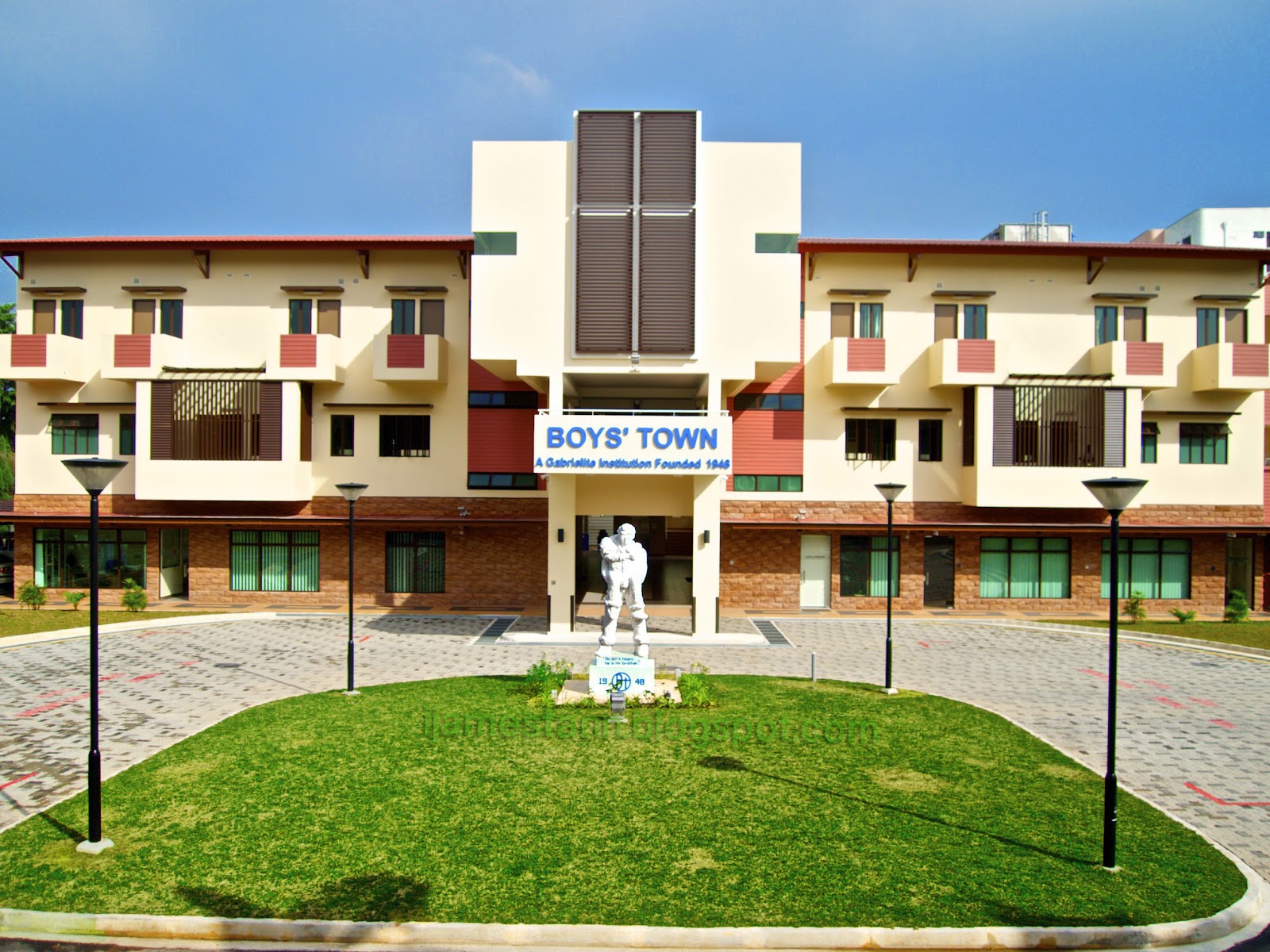
Places around P.E.E. (7) - Boys Town


He ain’t heavy, he’s my brother.


You may have heard these lyrics as part of a popular song made famous by The Hollies.
But did you know that this is the motto of Boys Town?
 In one simple phrase it tells all that they strive for.

Boys Town in Singapore was set up in 1948 as a result of the meeting of two men with a singular vision. 
Canadian Bro Vincent and Australian philanthropist 
Mr W. McDermott were both prisoners of war. 
While being interned at Changi Prison by the Japanese, they decided that upon release they would set up a facility to ensure that young boys could get the opportunity to lead better lives. And so, following their release at the end of WWII, they realized their vision by building Boys Town, modelled after the Boys Town of America.


Mr McDermott donated a sizeable chunk of his fortune, while Bro Vincent and his fellow brothers from the Brothers of St Gabriel religious order made up the teaching staff. They started initially with a small workshop built on the land that was beside St Joseph Church at Bukit Timah. 
Except for the land that belonged to the Catholic Church, they had to provide for everything else themselves. It was a herculean task at the time given that the war had just ended and supplies and money were in woeful shortage.

Their aim was to provide for boys, between 11 to 18 years old, a form of vocational education, guidance and support to see them through. Early vocational training included carpentry, motor mechanic, tailoring and printing. 

Over the years as Boys Town grew and became more established as a VITB training centre, it also took on main stream education, establishing Assumption English School to provide primary and secondary education. Recently, the Assumption Pathway School was set up to provide an education for children who are academically challenged.

The Assumption English School at Upper Bukit Timah.

While the schools are run independently, Boys Town Home is a separate entity and is best known as a boarding home for boys who may be less privileged, from troubled homes or in need of special support. 
The new Boys Town boarding home which can cater up to 60 boys annually.

Unfortunately, a wrong connotation is perceived by many who think that Boys Town is a place for wayward youth or for those with criminal records. This probably arose from confusion with the Singapore Boys Home where convicted young boys are incarcerated. The Singapore Boys Home is the government penal rehabilitation prison for male youth whilst Boys Town is a privately run charitable organization. However, with its established care programme, Boys Town has on occasions also accepted Court directed convicted boys for rehabilitation.

Boys Town is a registered charity but does not get funds from the government for any of its programmes. They depend solely on contributions from benefactors You can read more about this organization at their website here.
The old Boys Town building.

Bro Roger Venne, who has been at Boys Town since 1953,
giving me a quick tour of the new premises.

Wednesday, October 10, 2012

The kampong at Hillview Avenue.


There was a Chinese kampong (village) located beside the old Princess Elizabeth Estate at the northern end of Hillview Avenue.


According to old records found at St Joseph Church at Bukit Timah, in the closing years of the 19th century, there were some parishioners who lived in the valley between the church and the hill that would be later called Bukit Gombak. This valley was known as the Antonia Valley and had farms and some small gambier and pepper plantations. Thus, this kampong had a longer history than P.E. Estate which was only built in 1952.  Princess Elizabeth Estate presumably would have been built over parts of the old kampong.

Though I lived at the ‘modern’ Princess Elizabeth Estate, I can remember this kampong of my youth. It had a large number of typical kampong houses occupied mainly by Chinese families. You can tell the difference between the Chinese houses, which were built on cement foundation, from the Malay houses which tended to be built on stilts. Many of my schoolmates at P.E.E. School lived in this kampong.


Typical Chinese kampong houses found at Lorong Taluki

Although most of the kampong folks would just be tenants, there were some who had small farm plots on their homestead where they grew vegetables and other crops. Some grew fruits trees like durians and rambutans. I recalled that these farmers would carry their harvest in wicker baskets to the old Princess Elizabeth market to sell in the morning.
There was a large coconut plantation along Lorong Taluki which was the main track that ran from Upper Bukit Road through the kampong to Princess Elizabeth Estate. This unpaved dirt track was the shortcut for residents and was also used by students who studied at Boy’s Town or the Convent at Chestnut Drive.

Just before the KTM railway line at Lorong Taluki, there was a large scrap metal yard. I recalled that as a young boy, my school friends and I would scrounge around the construction sites of Popular Estate being built at that time for scrap copper wire. We would strip the plastic off the wires and sell the copper to this scrap yard. Usually we would get only a few cents but it was enough for us to buy ‘mica’ to make glass string for our kites.

The only time when this kampong made the news was in 1970 when one of the kampong folks discovered a four-legged chicken. The discovery of this quirk of nature was reported in all the local newspapers and for a while the kampong folks basked in their 15 minutes of fame.

Mrs Wong Yoke Siew with her 4 legged chicken.


This kampong survived till the late 1970s when the Housing & Development Board acquired the land to build the new HDB Hillview Estate. Part of the old kampong land was also acquired by Ministry of Defence (Mindef) to build their HQ Complex on the Bukit Gombak ridge.

Today, the site of the old kampong, and later Hillview Estate, will be housing the next chapter of occupancy with the rise of The Hillier Condominium, along with the yet unnamed condo complex beside it.

New condo developments on the old kampong site.


Related links: The HDB Hillview Estate

Sunday, September 2, 2012

The Anti-Catholic Riot of 1851.


This is my 3rd and last installment of the stories relating to the old cemetery at Chestnut Drive.
Previously I mentioned how the church of St Joseph and the cemetery came about and of how it was established by the early French missionaries.
After finding the old gravestones of the early pioneers of the church, I felt I had to tell their story.
A story of their zeal for conversions, their fortitude in hardship and deprivation, and their heroism against all odd in the jungles of Bukit Timah.


Historical records showed that even as Stamford Raffles signed the treaty with Sultan Hussein on 6 Feb 1819, there were already a number of gambier and pepper plantations on the island of Singapore.
Early Chinese farmers had migrated initially to Bintan and to the Riau Islands and later to Singapore to start gambier plantations. These were located mostly around the coastal areas that were then controlled by the Sultan of Johore under the kangchu system.
After Raffles established Singapore as a trading port, more Chinese learning of the new opportunities, and in desperation from the conflicts in China at the time, migrated to Singapore. By the 1840s, it was estimated that there were already 600 plantations all over the island. Most immigrants were indentured labourers and were under the control of clan associates. These clan associations started benevolently to help their fellow countrymen but criminal elements led to many becoming secret societies. The farmers and plantations were soon under the oppression of these secret societies, especially the most notorious Ghee Hin Huay.
There were some Teochew farmers who settled around the Kranji and Serangoon areas. Amongst these farmers were some that stood out from the rest. The reason being that they were Christians who had converted in China.
When the Catholic Church found out that there were Catholics at the gambier farms,  Fr Anatole Mauduit, a Chinese speaking French missionary, was dispatched to Kranji to minister to them.
The year was 1846. Getting to Kranji was by boat via the coastal route.

The route that was to become Bukit Timah Road was just mapped out the previous year.
However, this was not a road as you would imagine it today. It was still merely beaten tracks in most parts, through rugged jungle terrain with danger from marauding tigers. It was a track just wide enough for horses or bullocks, especially in the interior. *(The first recorded trans-island passage via Bukit Timah Road was undertaken by JT Thomson and Dr Robert Little. It took them 4 days by horseback)
As Kranji was 12 miles away from the city, Fr Mauduit chose to live near the plantations. He set up a chapel in the busiest settlement at Kranji. This was a village called BokoKang, located at the head of a tributary of the Kranji River. The location of BoKo Kang today would be somewhere in the Sungei Kadutold Yew Tee village area.
Map of northern Singapore in 1852  shows Bou Ko Kang (Bokokang) at the head of Sungei Kranji.
Leem Chu Kang plantation would be where Tengah Airbase lies today.
Chu Chu Kang village was resettled in the 1980s. Today Choa Chu Kang HDB estate is built upon it.
Lau Chu Kang was where the Singapore Turf Club at Kranji now lies.
Tan Chu Kang plantation was where today's Woodlands Garden up to the Customs building is located (Marsiling).
Fr Mauduit and his assistant, Fr Adolf Issaly, were true missionaries in ministering to their flock. They were so successful that their community grew from an initial 100 to 300 members by 1851. However, their success led to increasing tension between the church and the secret societies.
The clan huays saw it as an infringement into their domain. This was more so because the Catholic farmers did not take part in the clan temple ceremonies and would not contribute tithes to these.
The increasing defections from the clans by converts to the church angered the huays. They felt the conversions were tantamount to a loss of their control and influence over the farmers. The secret societies were determined to stop further defections from their clans and to reduce the missionaries’ influence.
All these simmering tension finally came to a head on 15 February 1851, when mobs from the secret societies went on the rampage to burn and ravage all the Catholic farms. Looting, theft and robberies were widespread and the Catholic farmers had to flee for safety. Some farmers fought back to defend their farms but most fled for safety to the city.
This incident which lasted for 5 days is known as the Anti-Catholic Riot of 1851.
In all, about 30 farms were destroyed, including non-Catholic farms that were torched during the fight. The riot did not only affect the Catholic farms at Kranji and Bukit Timah but spread to other parts of Singapore, notably in the Serangoon (Hougang) area, as well.

The Empire Strikes back.
A little known fact as to why the attacks took place on 15 Feb 1851 was that Fr Mauduit was away in France on sick leave, leaving Fr Issaly in charge. On the day of commencement of the attacks, Fr Issaly was called to attend to a sick parishioner’s wife at Sungei Benoi in Jurong.  Both being absent from their station was the impetus that led the huays to begin their pillage on the Catholic farmers.
Fr Issaly, on learning about the attacks at Kranji, took refuge for a day in Jurong. He learnt that there was a price placed on his head by the secret society. Fr Issaly through the help of Catholics in Jurong managed to secure a boatman who ferried him down the coast to the city.
Together with the refugee farmers, Fr Issaly applied for twenty-two warrants from the Police. Thus, the authorities had no choice but to enter the fray to enforce the warrants to recover the Catholic farms.
Up till then, the local British government were want to interfere into the affairs of the ethnic locals, especially of those outside of the city. 
Reinforcement for the Police, including a gunboat with 12 men, were sent to Kranji. The police force faced running battles with armed secret society fighters and there were killings and mayhem on both sides although the exact numbers were not known. It took 5 days before a truce was worked out between the government and the clan associations.
It was an uneasy peace as the secret societies had a number of fighters arrested and they refused to negotiate, not wanting to recognise the authority of the ‘foreigners’. It took clan and community leaders like Seah Eu Chin to finally make all come to a compromise. The government insisted on some convictions to show their authority with a few gang members ‘transported’ to India to serve their sentence. Other charges would be dropped in favour of a $1,500 compensation to the affected farmers. The farmers were unsatisfied with the paltry monetary compensation.

The myth of the 500 martyrs.
There is a long running story that 500 Catholics were slaughtered during this riot of 1851.
Many Catholics would like to believe that because if it were true, they would be the 1st known local martyrs, having died for their faith.
However, a detailed reading of the facts will show that the number is greatly exaggerated.
In 1851, the Catholic community in Singapore only numbered a few hundreds.
It was known that Kranji had about 300. Therefore, having 500 slaughtered for the faith cannot be plausibly reconciled. It would mean decimation for the local flock and yet not a single report was made to this effect. Even Bishop Bocho never mentioned any great loss to his congregation at this time in any of his records.
In fact, the Overland Free Press reported on 5th March 1851 that only ‘ten to a dozen’ people were killed, and this was the count from the Police side firing their muskets!
There were also no reports in the Singapore Free Press at the time about any massacre of these numbers. Therefore, the story of the 500 martyrs remains implausibe and should be debunked.
There may possibly be some Catholic farmers who were killed during the riots but there has been no official record of any of these anywhere.
The story of the 500 martyrs probably arose because of a confusion with another incident around the time. It was actually the Hokkien-Teochew Riot of 1854 that a great number of Chinese were killed.
Said to be between 200-300 (some reports did mention 500 killed) during 2 weeks of intense violence.

This other event in the later years was a much bigger incident starting from the city and spreading throughout the entire island of Singapore. It involved several thousand rioters fighting over dialectic territories. This incident is also known as the Five Catties of Rice Riots.
This is probably the source* and mix-up for the myth of the 500 martyrs as it occurred around the same time. Compared to the widespread Hokkien-Teochew Riot of 1854, the Anti-Catholic Riot of 1851 was considered only a localised incident, i.e. between the Church and the secret societies, and did not involve the majority of the Chinese community at that time.

*See comments below

The French Missionaries today.
The French mission of which Fr Mauduit and Fr Issaly belonged, the  Missions Etrangere De Paris or MEP, still exists today and are still running their mission in Singapore. They have been in existence since 1658 and together with the Franciscans and Jesuits were responsible for bringing Christianity to Asia, notably in China, Vietnam, Korea and Japan.


Related links:

Friday, August 24, 2012

The French Connection

This post is a follow up to my earlier article about the century old cemetery at Chestnut Drive.
I want to focus on the early pioneers living around Upper Bukit Timah area from where eventually my old village Princess Elizabeth Estate would be a part of.
In particular this is my tribute to Father Anatole Mauduit and Father Jean Marie Belliot, two giants who built the pioneering community around the area.

In the early days of Singapore, even before the Raffles founding of 1819, there were already Chinese immigrants working on gambier and pepper plantations on the island. Gambier was a plant that was used with the chewing of betel nuts and was also used for dyeing and tanning of leather.
It was the cash corp of its day.

A gambier plantation.
Gambier and pepper plants grew on the same vine and had a symbiotic nature.

This is an antique map of Singapore in 1852 showing areas of pepper and gambier plantations around the northern Upper Bukit Timah region.
Click on map for a detailed enlarged view.
The plantations were organised under a land tenure system called "kangchu"(  港主 ) in the Chinese Teochew dialect. Each kangchu (translated as 'river master') was led by a headman whose name gave rise to the area. The kangchu obtained his grant directly from the Temengong of Johor, which gave him the right to farm the river side lands.

In the above map you can see kangchus marked and named as Leem Chu Kang, Chu Chu Kang, Lau Chu Kang, Tan Chu Kang, Nam To Kang and Chan Chu Kang.
Some of these areas are still known by these names today like Yio Chu Kang, Choa Chu Kang and Lim Chu Kang. That was how the term 'chu kang' ( 厝港 ) meaning kangchu settlements came about.

While Raffles was a visionary who planned for the commercial success of the island, there was another group of men who had an equal vision for the betterment of the populace. These were the French missionaries from the society called Missions Etrangere De Paris or MEP.

Besides evangelisation, they reached out to the early settlers through building of churches and schools. Father Jean Beurel, who was head of the local mission then, built the Church of the Good Shepherd at Bras Basah, St Joseph's Institution, the Church of Ss Peter and Paul at Queen Street and the CHIJ Convent at Victoria Street.

He sent Father Anatole Mauduit to set up St Joseph Church at Kranji in 1846 where there were about a hundred Catholics working in the gambier plantations.
Initially, Father Mauduit, with the assistance of Fr Adolphe Issaly, started the church at Kranji at a village called Boko Kang but moved to the present location after Fr Beurel bought 30 acres of jungle land from the English East India Company. This new location was about 3 miles south from Kranji along Bukit Timah Road.
The title deed from the East India Co. for the purchase of the Bukit Timah land, 26 Aug 1851.


They built a church of wood on the hilltop, which was known locally known as Tek Ko Swa, with space reserved for a cemetery at the rear. (Tek Ko Swa is Teochew for bamboo hill). The church was completed in 1853.

The 1st St Joseph Church in Bukit Timah built by Fr. Mauduit and completed in 1853.
( Photo c.1901 - Source: Rev Fr Rene Challet MEP)


It was to this small wooden church (pictured above) that the famous explorer and naturalist, Alfred Russel Wallace, came to in 1854 to study the fauna and flora of the region. Alfred Russel Wallace was later to co-found the Theory of Evolution with Charles Darwin, based in part on the studies he made around Bukit Timah.

Father Mauduit died in 1858. For the next twenty years, the french MEP missionaries continued the work of ministering to the people in the rural northern regions. In 1878, came Father Jean-Marie Belliot, who was to stay on for the next 54 years at St Joseph.

In 1905, Father Belliot re-built the church, replacing the wooden building with a new paladin style church that would last till 1965.  Fr Mauduit and Fr Belliot both died in Singapore and were buried in the small cemetery behind the church that they built.

The church built by Father Belliot in 1905. ( Picture taken around 1960.)

Here is an extract from the book "The French in Singapore" by Maxim Pilon & Daniele Weiler. It tells of the hardships faced by the early missionaries in the tiger infested and Chinese gang controlled region of Bukit Timah.
"Life on the plantation was harsh: the workers were poor, and the dangers constant. An MEP report states: At Singapore, the Chinese Church is within the forest. The zeal of Father Mauduit had overcome all the obstacles and his little flock is increasing everyday. His catechumens are admirable, full of simplicity and fervour. They are poor, and their priest even poorer than them all; he considers himself lucky when he gets enough rice and plantains for his meals."


MEP missionaries who served at St Joseph Church
Dates indicate period at St Joseph Church Bukit Timah.
Anatole Mauduit, 1846-1858*
Adolphe MF Issaly**, (curate),1847 - 1853,
Ambrose Maistre, 1858-1860
Augustin Perie, 1860-62, 1868-1870
Adolf Issaly, 1864-1866 & in1871
Jean Pierre Remes, 1863-1864
Peter F Sorin, 1866-1868
JM Eugene Roussereau, 1870-1871
Elisee F Delouette, 1872 – 1876*
C J Saleilles, 1877-1881
Jean-Marie Belliot, 1878-1934*
L J Galmel, 1883-1885
Rene Challet, 1972-1977
Felix Brygier (curate), 1974-1982***
Louis Amiotte-Suchet, 1982-1986.

Other MEP Missionaries buried at St Joseph Church cemetery
Christopher Mazery *
Joseph Alibert*
Gustave Derenne *
Alexandre Blanchet *
Claude C Tisserrand *
Rene Girard*


*   Buried in the Cemetery at St Joseph Church Bukit Timah.
** Fr Issaly is buried at Church of Ss Peter & Paul,Queen Street.
*** Fr Felix Brygier is interred at the St Teresa Church, Kampong Bahru.


Related links: The cemetery at Chestnut Drive.
                       The Anti-catholic Riot of 1851
                       St Joseph Church Bukit Timah 1965
                       Alfred Russel Wallace
                       Photos of St Joseph parish cemetery


Tuesday, February 7, 2012

The Friars of Hillview (2)

THE FRIARS HAVE ARRIVED.

In an earlier blog, I introduced the Franciscan Friars who live at the hilltop of what is now the Church of St Mary of the Angels at Bukit Batok.

Historically, there were 2 different groups of Franciscan friars who worked at Bukit Batok.
The 1st group arrived in 1958. This group was the international chinese scholars whose given task was to produce anti-communist literature to counter the threat of communism in the region.


This group of friars was more reclusive as their priority was not directly to the catholics living in the district. They stayed from 1958 till 1970 when when they moved their Studium Sociologicum to Taiwan.

The 2nd group of Franciscan Friars were from Australia.
They came after the Archbishop of Singapore requested for their assistance in running a new parish. This new parish, or church administrative district, was carved out of the huge domain of St Joseph Bukit Timah.
This later group of 4 Friars were tasked to look after the welfare of the Catholics living in an area marked out in Bukit Batok, Jurong East and parts of Bukit Timah area.

Catholics living at Hillview and Princess Elizabeth Estate were in a quandary.
The new Franciscan parish church was at their doorstep, just a short distance away down Hillview Avenue. It was easier to get to St Mary than their own parish church St Joseph at Upper Bukit Timah.
But 'technically', they were still within the boundary of St Joseph's.
Should they 'defect' and join the new church out of convenience?
It was left to the Catholics themselves to decide which church to attend.
So, many like myself, found ourselves shuttling between the two but most eventually settled for one or the other.

The Australian friars slowly built up the community from an initial 20 rural families to today's congregation of over 7,000. The Australian friars have now been replaced by local friars whom they had trained up over the years.


A SAINT AMONG THEM
The Christian faith calls for all believers to be saints, i.e. to be holy.
The honorific 'St.' conferred by the Catholic Church goes beyond this call.
Among the millions of believers over the centuries, occasionally one or two individuals pops up who, by their lives or work, exemplifies holiness beyond the norm.

It is not easy at all for a Catholic to be a Saint.
Firstly, you got be be dead!
Then, whilst being dead, you have to perform two verified miracles.
How is this so? Like I said, it is not easy.

If Singapore were to lay claim on anyone who might possibly be a Saint, the nearest candidate would be someone very few would have heard of. He lived and worked at St Anthony Friary located at Old Jurong Road for two and half years as part of the team fighting communism in S.E.Asia.
His name is Friar Gabriel Allegra, originally from Sicily, Italy. He lived in Singapore from 1961 to 1963.

Fra Gabriel Allegra OFM.
Unlike other 'famous' personalities who may, or may not, eventually be called Saints like Mother Teresa of Calcutta or Pope John Paul II who visited Singapore,  Friar Allegra actually lived in Singapore and would have moved all around the Bukit Batok area.

Friar Gabriel Allegra was the first person to translate the entire Bible into Chinese. His translation is still used as the definitive translation in the Catholic Church today. His cause for promotion to Sainthood is being actively promoted by the church in Hong Kong where he spent the last days of his life. He died in 1976.
In 1996, Pope John Paul II pronounced Gabriel Allegra as "Blessed', passing the 1st stage in the long process in gaining Sainthood. And yes, one miracle has been attributed to him. The Church needs another to qualify him as an official 'Saint'.

I recall speaking to another friar around 1990, Fr Fulgence Gross, who was one of the original chinese scholars and I asked him about Friar Allegra. "Oh, I couldn't stand that guy!", he exclaimed, "He was too good!"

In the early 1960s, I was too young to intimately know Friar Gabriel, unlike my parents who did, but even having met him when I was a young boy,  I hope that one day he will be officially named a Saint, so that we can claim him as one of our our own.

Wednesday, January 4, 2012

Places around P.E.E. (2) - St Joseph Church, Bukit Timah

For a small estate of 200 households, there was an exceptionally large proportion of Catholics living at Princess Elizabeth Estate. Most of them attended the nearby St Joseph Church. It was usual to either walk to church through the Lorong Taluki kampong or by bus to the Salvation Army bus stop at Hillview Road and walk the short distance to church.

St Joseph Church, re-built by Fr Teng in 1965.
For administrative purposes, the Catholic church is divided into dioceses, each run by a bishop, and further sub-divided into parishes for easy administration. So the parish priest would be the one you may be most familiar with as he tends to the area where you lived.

P.E. Estate came under the domain of St Joseph Church at Upper Bukit Timah Road. The parish priest at that time was a dominating larger than life figure called Fr Joachim Teng. With his booming voice, he sent shivers through many parishioners and really scared the hell out of a lot them! (In the process I guess saving them for heaven).  Children ran away at his sight. Yet Fr Teng tended his flock zealously, going round his parish that once stretched from Jurong to Woodlands. Older parishioners will recall him riding his British Matchless motorbike in his cassock!

Fr Teng was renowned as a church builder. He is credited with building St Francis of Assisi at Boon Lay, St Anthony at Mandai, St Stephen at Aljunied, and of course, the re-building of St Joseph at Bukit Timah.
For all his efforts, the government awarded him the Public Service Star. Fr Teng died in 1984.

Fr Joachim Teng

St Joseph Church at Bukit Timah has a long and illustrious history. It was built in 1846 by French missionaries to tend to the rural catholic population.  St Joseph used to own huge plots of land around the church at the Chestnut/Cashew area. Boys Town & the CHIJ convent were all built on land previously own by St Joseph Church. It was also one of the few churches that had its own cemetery by the church.

I had blogged once before about St Joseph (article here). The famous explorer and naturalist, Alfred Russel Wallace also used St Joseph Church as his base in his early research into natural evolution (see this article here)

St Joseph Church. c.1905.

My earliest recollection of St Joseph as a child around 6 or 7 years, was of the doric columns and the huge  statue of St Joseph at the door way. At the main door there were two giant clam shells which was used to hold holy water. I recall playing on the stone steps leading up to church. They were covered with moss wherever there was a joint or crack. One scary thing for a child was being told that the graves of the early parish priests were buried in the aisle of the church. We were always afraid of stepping over their grave stones!


The church was already at that time getting old and run down. This church that I attended as a child was actually the second St Joseph church building that was erected in 1905 to replace the original wooden building.  Fr Teng initiated the 3rd re-building of a new St Joseph in 1963 and was completed in 1965.


For those who may be unfamiliar with Catholic practices, the Catholic Church is 'universal'. It is the same church wherever you go. It has the same beliefs, the same rituals and the same dogmas whether you are in Singapore, Australia, Africa or anywhere. Your 'membership' comes with your faith and baptism. Catholics may attend any church in the world and the only difference may be the vernacular.

A dilemma arose for Catholics in Princess Elizabeth Estate in the early 1970s when another Catholic Church was built at the other end of Hillview Ave on Old Jurong Road. That will be in another blog....

Related posts: History of St Joseph Church Bukit Timah
                       The cemetery at St Joseph Church