Showing posts with label Malayan Guttas. Show all posts

Wednesday, December 9, 2020

Malayan Guttas Vintage Photographs

Malayan Guttas Ltd  was a pioneer factory at Hillview, Bukit Timah. 
Many of you may never have heard of this company,  unless perhaps, you once lived nearby around Hillview or you might have known of it perusing through this blog of mine where I had previously written a few articles about it. (links below)

However, you will definitely recall its most famous product - the Wrigley Spearmint Chewing Gum.
The Wrigley Company of Chicago USA set up the factory in 1947 soon after the end of World War Two.

Following the end of war, the British Government offered extremely good incentives for foreign companies to invest in the colonies to revive the war-torn countries' economies. One major incentive was that their manufactured goods would be entirely tax-free if it was manufactured, distributed and sold in any British Commonwealth nation.

As a result, Malayan Guttas became the biggest manufacturer and distributor of chewing gum in all the British Commonwealth out from its factory in Singapore.
The other major incentive for Malayan Guttas was that its principal ingredient for making chewing gum could only be found in the Malay Peninsula, i.e. the then Malaya, Borneo and Indonesia. This was the resin Gutta Percha.


Gutta Percha resin is the inedible bit that gum chewers spat out and made a mess of the sidewalks!
Gutta Percha came from the endemic Sapodilla tree, of which the Chiku fruit tree was one species.
However, extracting the gutta percha resin was primitive even in those days. It had an unsustainable and destructive process in its extraction. They had to chop the entire tree down to bits and boil the wood to extract the resin. 
By the 1960s, due to the scarcity of the Sapodilla trees, they switched to the resin of the Jelutong tree. So Malayan Guttas became the biggest source of Jelutong resin and the centre for worldwide distribution.

Ironically, chewing gum was banned in Singapore in 1992 but by a strange twist of fate, the entire region of Hillview where the factory sat was then re-designated into a 'residential development zone'. The Wrigley Company sold the land to a private developer for a fortune in the late 1990s. The land was developed into the now Hillington Condominium complex.


The newly built Malayan Guttas factory in 1948.


Recently, I was very fortunate to receive a package of old photos from Switzerland.
It came from Pierre-Yves Bünzli, son of Mr Bünzli who was the General Manager in the late 50s to the early 60s.
In those days, the GM was numero uno. He oversaw the entire operations and personally lead many expeditions to Borneo to source for Jelutong resin.

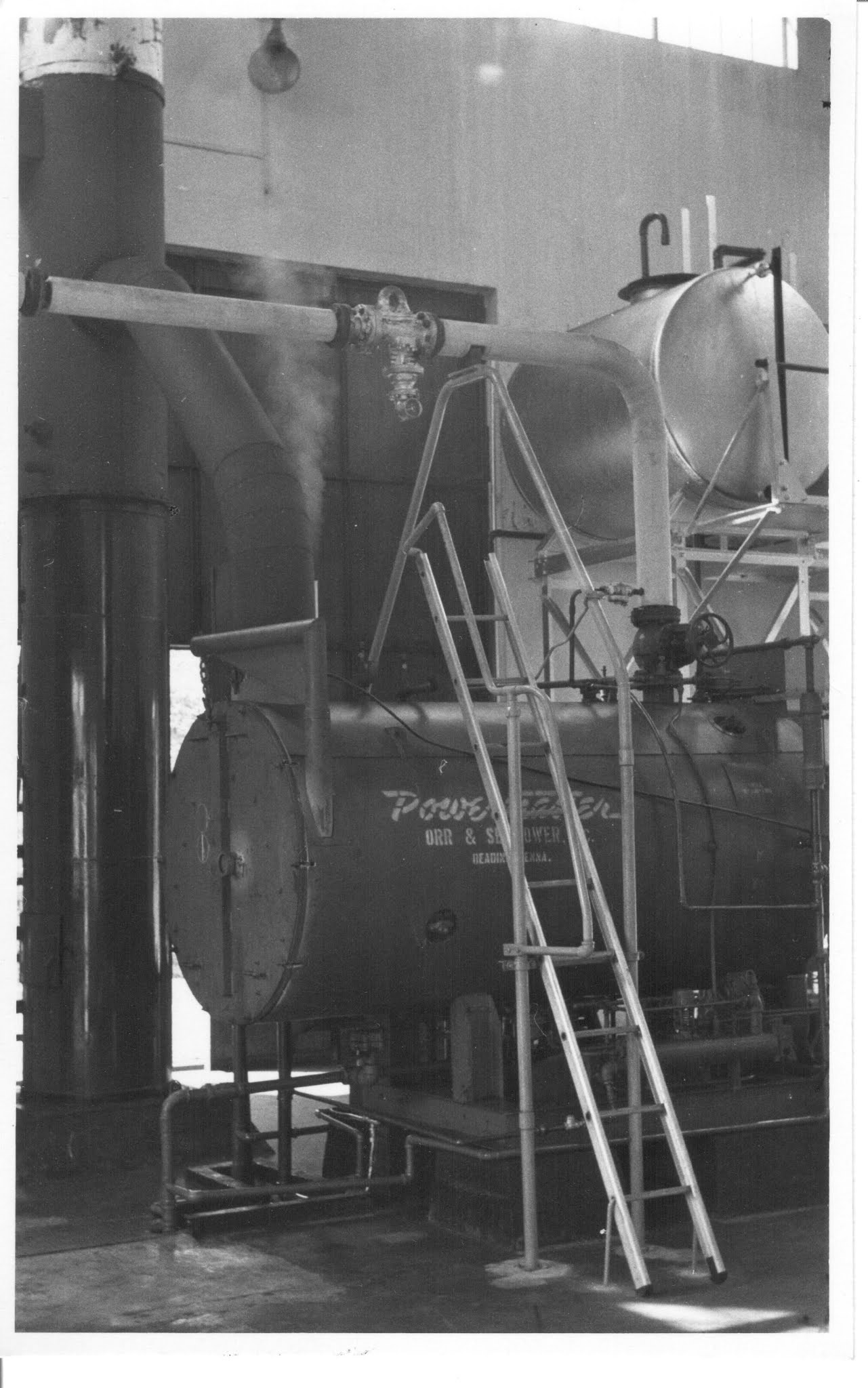
The cache of vintage pictures, of which I will release periodically in future articles, were of the factory operations and of the staff.  Many of the staff were from the old Princess Elizabeth Estate and if you do recognise anyone of them in the photos, please comment below.


The cache of vintage photos I received.


The machinery used in the resin extraction


The boilers used for resin extraction


Crates of resin extract stored at the back


Staff Group Photo c.1962


Staff function at the factory grounds.


Saturday, November 19, 2016

Sixty-six years ago over Hillview

I found another old RAF aerial photograph, taken in 1950, of the area above what would become Hillview Avenue.


At the end of World War II, the British Military Administration, in order to conduct a mapping survey of Singapore Island, found that the fastest way then, given the limited resources, was to do an aerial photo mapping survey. The task was given to the RAF Photo Reconnaissance Squadron 81.
The magnificent pictures they took are now in the National Archives.

In 1950, Princess Elizabeth Estate was not constructed yet as the site was only considered in 1951.
Union Carbide Co Ltd, maker of the Eveready Batteries, and Malayan Guttas Ltd, manufacturer of Wrigley Chewing Gum, were the only factories then located at Hillview Road. The massive factory complex on the right of the picture is the Hume Pipe factory wth the Manager's Staff Housing located behind on Hume Heights.

Fuyong Estate, which was built by philanthropist Lee Kong Chian, was a row of houses facing Upper Bukit Timah Road. These were meant as low cost houses to cater to the shortage of housing in those days. This row of houses is still in existence today, but has been converted as eateries and restaurants called Rail Mall.. Terrace houses would later be privately built behind the row of low cost housing and incorporated as part of Fuyong Estate.

On the top left are the Public Works Dept (PWD) offices which ran the adjacent PWD granite quarry for gravel used mainly for road building works. Part of the pastureland of The Cold Storage Dairy Farm can be seen beside the PWD offices.

On the top right is the Singapore Quarry, privately owned by Mr Chia Eng Say, whose namesake is now given to the road fronting Rail Mall at Fuyong Estate.

Notice the KTM railway line that runs across the picture with the grider bridge over Hillview Road.
If you look very carefully at the land just beside Upper Bukit Timah Road, left from the black truss  bridge onwards, you will see some remnants of long streaks in the ground.

These long streaks were the original Tank Road-Kranji Railway line that ran alongside Upper Bukit Timah Road. (You didn't know that, right?) The  old railway line was dismantled and replaced by the KTM Line that was built further uphill. The 1957 Chartered Bank would be built over the old track line.

Click on the picture to get a more detailed and enlarged view.


Monday, November 19, 2012

Guest blogger - Grace Seah


My dad used to work at Malayan Guttas as the Bookkeeper/Clerk in their office.  
We seem to have an endless supply of Wrigley's chewing gum at home during those days but funny enough I never enjoyed them!  My dad used to call the base product that was manufactured at the factory as jelutong.

The Malayan Guttas factory with Princess Elizabeth Estate in the foreground.

The American bosses at Malayan Guttas were very kind to their staff.  
One story my father told me was that most residents at P.E.E. were from low income families who worked in that vicinity.  

When my parents first moved to the estate, they didnt have much savings and so my dad on his first day of work had no proper shoes to wear.  
Instead he patched his old pair of shoes by hand just so they wont fall apart when he walked, hoping to be able to afford a new pair by the next pay day.  
His American boss saw that and immediately arranged for a salary advance on his first day of work so that my dad could buy new shoes to wear to work.  

That story of kindness has stayed in my memory ever since. In fact I ended up being his boss daughter's penpal for many years. She lived on Staten Island, New York and we corresponded by letters for many years. 

My dad and his colleague working at Malayan Guttas.

My dad continued to work at Malayan Guttas after we left right up to the day he retired.  
(After moving out in 1968) he ploughed all the way there and back from East Coast Road to Bukit Timah and back everyday to earn a living for his family.

I would pine for my old school and I even begged my parents to let me follow dad to school everyday. But of course that would have been so impractical.

My mum would tell me that for a long time after we moved out of our flat, during lunch time, my dad would drive over to the green park just infront of our flat and sit under the beautiful flame of the forest tree and just stare at the balcony of our flat in silence, just reminiscing of precious days gone by. 


Wednesday, January 25, 2012

Factories around P.E.E (5) - Malayan Guttas

NO MORE CHEWING GUM FROM PRINCESS ELIZABETH ESTATE!

As I mentioned in my previous blog, I was taking my visiting sister and nieces around Princess Elizabeth for my sis Jen to show her daughter the old abode. After seeing the old primary school, mention was made of the old sports 'houses'.

All the schoolchildren were divided into 4 sports houses. These 'houses', a typically British tradition of naming sport teams in a school, were Kiwi House, Gammon House, Hume House and Guttas House.

The Houses were 'adopted' by the major factories located around Princess Elizabeth Estate.
These companies sponsored the purchase of sports equipment for the school when it was set up and the sport houses were named after them in appreciation.

Among the four, I believe fewer would know of The Malayan Guttas Company.
In reality, Malayan Guttas was the biggest processor and supplier of Gutta Percha in the region.
What in the world is Gutta Percha, you ask?
Frankly, even I didn't know what gutta-percha was until many many years later when I was a young working adult!
And I am very sure a lot of you would still not have heard of it till now.

Gutta Percha is a rubber like substance made from sap of the the Palaquim (chiku) tree. The sap on processing became a rubber-like substance that was very pliable and not stiff like vulcanized rubber.
Gutta percha trees were indigenous to the Malay Archipelago. The anglicized word gutta percha comes from the Malay getah perca meaning rubber sap. It was used in place of natural rubber for things like medical gloves, dental fillings and especially for electrical cable insulation.


Its discovery was mainly credited to Dr. William Mongomerie, a military doctor with the East India Company, who was stationed in Singapore with William Faquhar, the Resident appointed by Raffles. Montgomerie noticed the substance being used by native Malays to make handles for their parangs (machetes). Montgomerie researched and promoted its use as a surgical covering for medical equipment, being inert to solvents.

Unknown to many, it was also the secret ingredient for another famous product.

The chiku tree was a source of gutta percha
Besides being the major processor and supplier of this raw gutta percha, the Malayan Guttas Company was more famous for another product it manufactured at Hillview Avenue.
This was the Wrigley Chewing Gum.
Older residents at P.E.E. would only know the factory as 'the chewing gum factory'.

Gutta percha was the major component of chewing gum.
It was the inedible sticky stuff that you chewed on and when spat out caused all sorts of disgusting sticky situations!
This factory at Hillview Avenue supplied Wrigley worldwide the substance to make chewing gum.


Of course, we all know of the infamous 1992 Singapore ban on chewing gum.
But by this time, gutta percha was no longer used in chewing gum in favour of other chemically made substances. This led to the factory land being sold to property developers eventually after the area was rezoned. I guess it was fortuitous for the parent  company as they made a nice profit from the land sale.
The parent company of Malayan Guttas Ltd at Hillview was the Wrigley Company of USA.

Today, on the site of the former Malayan Guttas factory sits the Hillington Green and Summerhill condominiums.

postscript: 10 Feb 2012.
I found an old archive photo of the Malayan Guttas factory.


The Malayan Guttas factory at Hillview Avenue.
Over the years. the row of Casuarina trees grew to full height about 15m and a the distinguishing landmark.


Vintage photos of Malayan Guttas factory operations.