
Wednesday, August 4, 2021
The hidden waterfall at Bukit Batok
There is a beautiful cascading waterfall at Bukit Batok.
Most people would not even see it when it is in plain sight.
There is a magical secret to this!

Many of you may have noticed that even whilst we are in a pandemic situation, a lot of people have found new ways to relieve stress. One of the most visible that I have seen is that more people have been out to the parks, nature trails and forest reserves and in bigger numbers than the usual.
As a result of sharings on social media, more people are finding places that were once unknown to most.
Two of these lesser known places are the former Bukit Batok Hillside Park, as well as the Bukit Gombak Nature Park. They have been closed for more than twenty years now for various reasons, mainly for public safety.
In this article, I will tell you some secrets of the Bukit Batok Hillside Park located at Bukit Batok West Avenue 2, especially of its hidden waterfall.
Bukit Batok Hillside Park was created in the early 1990s. It was designed by the HDB based on a totally new concept then.
While most HDB neighbourhood parks were built within the housing precinct and thus would be basically 'flat' and built on cleared land making them easily accessible, the Hillside Park was designed to be a 'rugged' countryside park instead.
In early 1990, HDB's Principal Architect, Ms Evelyn Chua, on a trip to New Zealand was inspired by how the Kiwis preserved their natural terrain and natural vegetation in creating nature parks.
 |
| New Zealand Nature Park |
In trying to emulate this concept, HDB planners found that the hilly Bukit Batok region was ideal for this kind of natural rugged parkland.
It had natural hills, was forested, had natural springs and had rocky outcrops to emulate mountain climbing features. Importantly, it was also isolated and away from the bustling new town, giving it a 'getting away from civilisation' feeling.
The intention was to keep it as pure and natural where possible. Making full use of the terrain, the rocky outcrops for hiking trails and using the forest flora supplementing it with local palms, ferns and rhododendrons for the more general public areas.
A lot of the secondary forest would be kept natural with only prepared trails in, to minimise damage to the natural vegetation. It would be a park not just for the general public but would also cater to those who prefer a hardier hike or climb or some jungle trekking.
For the general public, the Park was built with an 'enchanted forest' theme. There were cobblestone paths, a wishing well, floral pergolas and gazebos built all around the hillside where you could gaze on the developing Bukit Gombak New Town below. It would be like walking through a floral wonderland from one place to another through the pergolas to the gazebos.
But the best feature was a hidden waterfall that could be seen only when the conditions were right.
The Park was completed in early 1990 and was handed over to the Choa Chu Kang Town Council as part of their town facilities. Choa Chu Kang Town Council was in charge of that area of Bukit Batok at the time as part of their constituency. The Town Council renamed the new park as Greenwood Park, however, the name did not last and was forgotten by most and was never included in further official listings when the park was closed for the reasons I will explain below.
 |
| Photos by ©EngOng Bluefly |
THE PUBLIC WAS NOT READY.
Alas, Hillside Park was not popular for the very same reasons that they expected that it would be.
It was too rugged, people found it too hard to climb about the rocky surface, the slopes were too steep for comfort, there were no handrails along the paths, and the park features felt a bit fake, a bit out of place.
Even simply to access the park, you had to climb a steep stairway of 10 metres just to reach the entrance. And it was too far away from most residents then, being isolated at the far end of Bukit Batok West at that time, while most of them were living in the eastern and central zones.
So the very reasons that they thought would make the park outstanding and unique became the very reasons for its downfall.
The public, especially residents of Bukit Batok, were not used to this new concept and most gave the park a miss due to these difficulties. So visitor traffic to the Park dwindle to almost zero over the next few years. It was the wrong type of park at the wrong time.
 |
| The Wishing Well |
For the Town Council, the park became a costly liability. It cost them more to maintain than there were visitors to justify its continued upkeep. However, they kept it going at that time as there were talks that a new statutory board was to be formed to take over the management of all parks in Singapore.
When NParks was formed to take over all Singapore parks, they decided not to upkeep the unpopular Hillside Park and so it was closed and left to fallow. It was eventually abandoned and the land was returned to the HDB. Over the years since, it was literally forgotten except by the few hardy explorers and 'ghost hunters' and it became a hidden gem for birders.
You can watch the accompanying video clip below that will show you some of the remnants of the features that were in the park. The video was done more for the birding community but it will also show you a bit of the old park.
In this video, I also dispel the mistaken notion that the pergolas many hikers and explorers come across there were once Japanese "Torii Gates".
SO WHERE WAS THIS WATERFALL?
One of the most unique features of Hillside Park, one that can still be seen even today after being abandoned more than 20 years, is the hidden waterfall.
On a fine day, you won't be able to find it but when it rains, it appears like magic in the enchanted forest.
In this video, I also dispel the mistaken notion that the pergolas many hikers and explorers come across there were once Japanese "Torii Gates".
 |
| Definitely not Japanese Torii Gates! |
One of the most unique features of Hillside Park, one that can still be seen even today after being abandoned more than 20 years, is the hidden waterfall.
On a fine day, you won't be able to find it but when it rains, it appears like magic in the enchanted forest.
The main access into the park was a man-made rock stairway leading to the Wishing Well and the Gazebos.

The unique feature of this stairway was that all the drains around the park were directed towards it.
Whenever it rains, all the runoff rainwater would be channeled into this stairway causing the rainwater to cascade down the steps.
The heavier the rainfall, the larger would be the cascading waterfall.
This effect can still be seen today whenever it rains.
Whenever it rains, all the runoff rainwater would be channeled into this stairway causing the rainwater to cascade down the steps.
The heavier the rainfall, the larger would be the cascading waterfall.
This effect can still be seen today whenever it rains.


When NParks closed Bukit Batok Hillside Park to let it revert into a secondary forest, they removed the bottom half of this stairway to prevent the public from getting inside. The stairway was also covered with new plants to hide the entrance.

AN UNINTENDED DISASTER!
What NParks didn't realise then was that when the original hidden waterfall was put in, it was covered with a layer of Gunite (shotcrete). This layer of gunite, which is a type of concrete, was laid all over the stairway channel to prevent erosion of the soil when the waterfall effect happens during the rain.
HDB planners apparently knew that a gushing waterfall would soon erode the soil beneath but I guess NParks know more about flora and fauna than civil engineering. hee hee. just kidding.
NParks failed to recognise the ingenuity of the HDB architect's design.
Essentially, HDB had created a huge concrete 'longkang' (canal) to drain all the runoff rainwater away from the park. Creatively, they made that same longkang into a stairway as well. This canal/stairway would channel all the rainwater to the main drainage at the roadside. And in this process the magical waterfall would appear for those willing to wait in the rain.
Can you imagine what would happen if someone cut the longkang away?
As the erosion prevention layer was removed together with the lower half of the stairway, the bottom half of the waterfall channel has now eroded the hillside over the years and continues to pour rainwater and mud directly onto the roadside today.
The intact upper section of the stairway is still in excellent condition and hasn't eroded all these years.
The gunite layer also acted as a non-slip layer to allow people to walk through the cascade without falling.
LAST CHANCE TO SEE THE MAGICAL HIDDEN WATERFALL
Bukit Batok Hillside Park is slated to be re-developed for new flats over the coming years. A small replacement neighbourhood park would be built for the new residents on one side of the present hill by 2024. Today, Hillside Park has already been reduced to less than a quarter of what it originally was when it was built.
If you want to see this magical phenomena, go there soon before it is all gone.
But only when it rains!
If you intend to go further in, remember it is very, very slippery on the steep slopes during a rainfall.
Here is my accompanying video where you can see the fake cobblestone stairway that turns into a beautiful cascading waterfall during the rain.
If you prefer to watch in full screen or with subtitles, you can click on this link
What NParks didn't realise then was that when the original hidden waterfall was put in, it was covered with a layer of Gunite (shotcrete). This layer of gunite, which is a type of concrete, was laid all over the stairway channel to prevent erosion of the soil when the waterfall effect happens during the rain.
HDB planners apparently knew that a gushing waterfall would soon erode the soil beneath but I guess NParks know more about flora and fauna than civil engineering. hee hee. just kidding.
NParks failed to recognise the ingenuity of the HDB architect's design.
Essentially, HDB had created a huge concrete 'longkang' (canal) to drain all the runoff rainwater away from the park. Creatively, they made that same longkang into a stairway as well. This canal/stairway would channel all the rainwater to the main drainage at the roadside. And in this process the magical waterfall would appear for those willing to wait in the rain.
Can you imagine what would happen if someone cut the longkang away?
As the erosion prevention layer was removed together with the lower half of the stairway, the bottom half of the waterfall channel has now eroded the hillside over the years and continues to pour rainwater and mud directly onto the roadside today.
The intact upper section of the stairway is still in excellent condition and hasn't eroded all these years.
The gunite layer also acted as a non-slip layer to allow people to walk through the cascade without falling.
LAST CHANCE TO SEE THE MAGICAL HIDDEN WATERFALL
Bukit Batok Hillside Park is slated to be re-developed for new flats over the coming years. A small replacement neighbourhood park would be built for the new residents on one side of the present hill by 2024. Today, Hillside Park has already been reduced to less than a quarter of what it originally was when it was built.
If you want to see this magical phenomena, go there soon before it is all gone.
But only when it rains!
If you intend to go further in, remember it is very, very slippery on the steep slopes during a rainfall.
Here is my accompanying video where you can see the fake cobblestone stairway that turns into a beautiful cascading waterfall during the rain.
If you prefer to watch in full screen or with subtitles, you can click on this link
A word of thanks to my hiking friend Tan Kim Lai for the use of his photographs.

Wednesday, June 30, 2021
Hillview Haunted House - Exclusive Photos Part 2.
Hillview Mansion Exclusive Photos Part 1.
As for those who wish to read more of the supposedly haunted Hillview Mansion, you can click on the links at the end for the other past articles.
In this instalment, I will show you the driveway leading from Jalan Dermawan up to the front porch of the house. Why the driveway, you asked?
Well, beside the fact that it has never been seen before in any other media, the main gate, where the driveway starts, and the driveway itself are the only remnants of any original structure that still exists today. The retaining wall alongside the the driveway is included as part of the driveway itself.
As for those who wish to read more of the supposedly haunted Hillview Mansion, you can click on the links at the end for the other past articles.
In this instalment, I will show you the driveway leading from Jalan Dermawan up to the front porch of the house. Why the driveway, you asked?
Well, beside the fact that it has never been seen before in any other media, the main gate, where the driveway starts, and the driveway itself are the only remnants of any original structure that still exists today. The retaining wall alongside the the driveway is included as part of the driveway itself.
The main gate and the partial driveway are what most people have only seen of the 'haunted Hillview Mansion' for the past three decades.
HILLVIEW MANSION EXCLUSIVE PHOTOS - PART 2.

HILLVIEW MANSION EXCLUSIVE PHOTOS - PART 2.
 |
| The main gate to the property. |
 |
| The retaining wall was a necessity as the driveway was cut into the steep slope of Bukit Gombak. |
 |
| The incline up to the first bend. |
 |
| To reach the house, you needed to make at sharp turn at the hairpin bend. |
 |
| The driveway continues after the hairpin bend. |
 |
| The right turn to reach the top after the hairpin section. |
 |
| This structure had stairs that led to an underground space at the top corner of the driveway. |
 |
| This structure at the top turn had an underground level. Does anyone have an idea what it's purpose? |
 |
 |
| Arrival at the front porch and foyer of the mansion. |
 |
| The front porch and main entrance into the Hillview Mansion. |
The next instalment of this exclusive collection will take you into the interior of the house. There you will see some of the luxury fittings and the abandoned construction work that was stopped when the mansion was abruptly vacated in 1986.
Related links to the Hillview Mansion:-
The haunted house of Hillview
The burial of the Hillview Mansion
The landslides at the haunted grounds.
Why the Hillview Mansion was abruptly abandoned.
Exclusive Photos of Hillview House Part 1.
The haunted house of Hillview
The burial of the Hillview Mansion
The landslides at the haunted grounds.
Why the Hillview Mansion was abruptly abandoned.
Exclusive Photos of Hillview House Part 1.
Thursday, June 24, 2021
Hillview Haunted House - Exclusive Photos Part 1
I first wrote about the Hillview haunted house back in 2012.
Since then, I have updated this blog several times in the past with more related articles (links to those articles are below) to appease the undying curiosity of my readers.
This so called Hillview Mansion was abandoned in 1986 and left there uncompleted till it was demolished in the early 2000s.
Through the years since, strange incidents kept happening at that site such as recurring landslides, paranormal activities and people getting struck by lightning there.
This led to many people speculating that the site and the abandoned house had something that was not apparent, something not quite right about it, and so the stories began circulating and grew into a life of its own.
In 2019, I revealed why the house was abandoned. I also promised then to reveal the reasons why and how it perhaps became haunted.
However, at this time, I still can't reveal those reasons due to the fact that the person who survived the lightning strike has not given me permission to tell the story of that tragic day.
So please wait patiently for that coming article.
The house is no longer standing and the land is completely sealed off now.
But that hasn't stopped the curious, and many trespassers have been caught by the authorities over the years. Most of them due to their youthful exuberance and friends dares.
Lester Yeong, in his youth, was also one of those adventurers and explorers who had visited the Hillview Mansion on several occasions in the past due to its infamous history.
Being intrigued as to why the house seemed abandoned, he was brave and curious enough to risk entering back in the late 1990s when the house was still intact.
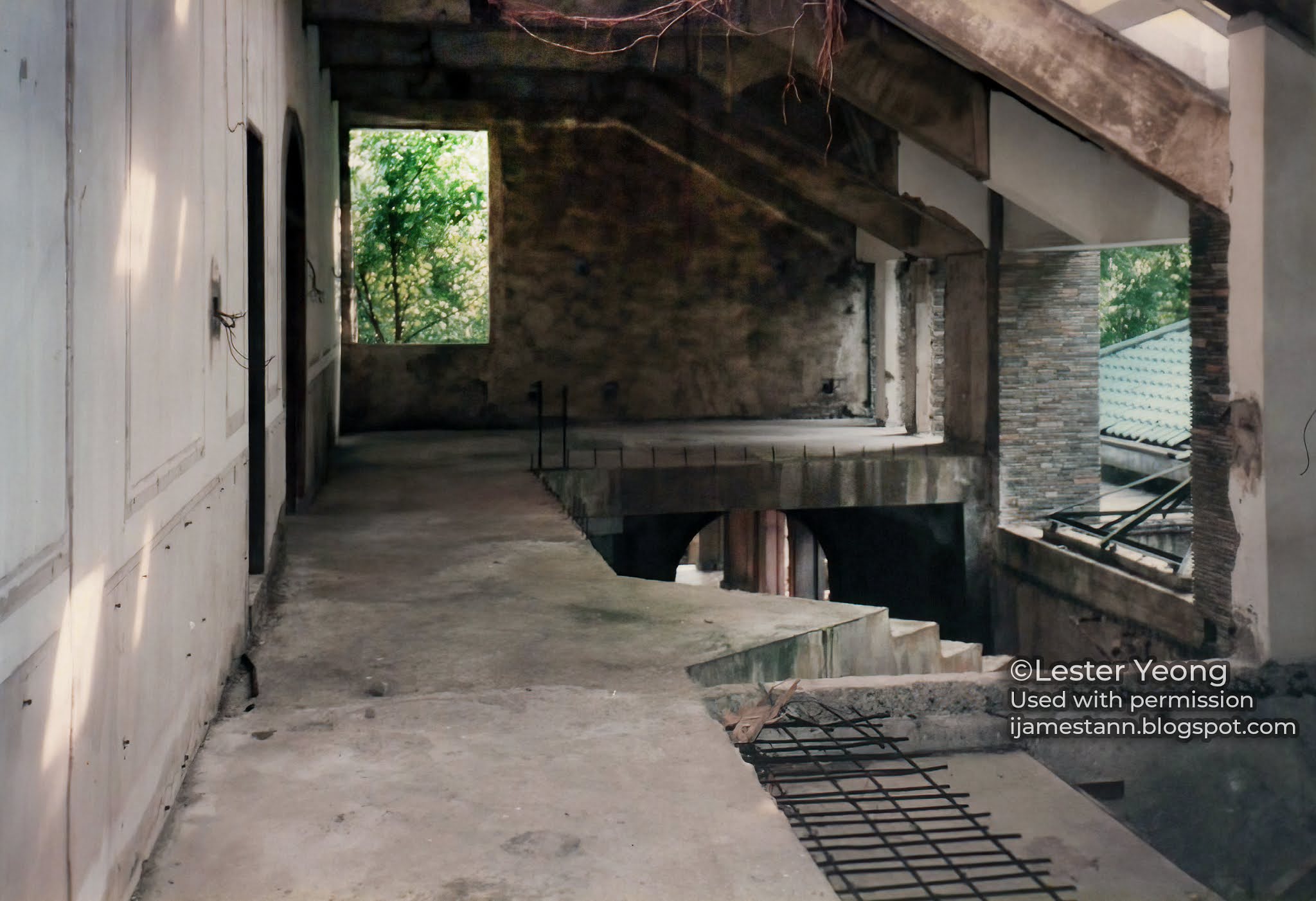
Nevertheless and most fortunate for all of us today was that Lester took a whole series of photographs of the abandoned Hillview house before it was demolished. This is treasure as there have been so few available photos of Hillview Mansion, especially of its interior!
Lester wrote to me and offered me the exclusive rights to publish these, till now, unseen photos in his collection. These were taken between 1998 and 2000. Being more than 20 years old and having been kept in his old albums, I tried as best as I could to restore some of the colours back into the faded photos. The collection has more than sixty photographs which shows the exterior, and the rarely seen interior of the house that Mr. Chua Boon Peng built at Hillview.
To prevent an information overload, I will publish Lester Yeong's photo collection over several parts. The first here with 12 photos to give you a taste of what's in store!
I will leave minimal captions on the photos but please do give me your feedback in the comment section below (don't forget to include your name in the comment, please)
For those who may not have seen the previous articles regarding the Haunted Hillview Mansion, I append some links here for your convenience:-
The burial of the Hillview Mansion
The landslides at the haunted site
Why the Hillview Mansion was abruptly abandoned


The landslides at the haunted site
Why the Hillview Mansion was abruptly abandoned
EXCLUSIVE PHOTOS OF THE HILLVIEW MANSION
 |
| This is the locked gate at Jalan Dermawan, familiar to those who have been there but seen from the property outwards with the familiar retaining wall at the side. Today, the gate and the wall are the only existing relics from the original construction. |

 |
| The view from the top balcony towards the condos along Hillview Avenue |




Tuesday, June 8, 2021
Photos from ex-residents (#23) - Gerald Cheah BK.
For many of us who grew up in Princess Elizabeth Estate, the primary school at Princess Elizabeth Drive was a big part of growing up there in our early school life.
Gerald Cheah Beng Kin moved with his family in 1955 and lived on the ground floor at Block 22 which was adjacent but nearer to the back of Princess Elizabeth Estate School. Spending his first six years of primary school there and leaving in 1960, he fondly recalls the Principal, Mr Ponnusamy, his scout master Mr Bernard Fernandez and his Science teacher Mr Nair.
Most memorable for him was his Geography teacher Mr Lim Mou Shen, who took his classmates all over the countryside in his car, especially to the mangrove swamps at Sungei Buloh where they would bring back root stumps to make handicraft like lamps stands and table legs.
Gerald was kind to send me photos to share on my blog in order that those who went to Princess Elizabeth Estate School would remember those days. Some of the photos below are not from his time at the school but were taken later after the demolition of the SIT estate.
 |
| The class of 1960. Gerald is second boy from the left. They are beside the dreaded mobile dental van that visit schools. |
 |
| Blk 3 of the HDB Hillview Estate. The old S.I.T. Princess Elizabeth Estate was located in the green field beside the HDB block of flats. |
 |
| The cleared land was where the old estate once stood. |


Sunday, May 9, 2021
The sarabat stalls at Hillview Road
A sarabat stall is basically a makeshift coffee stand, in days gone by.
Unlike an itinerant or travelling hawker, the sarabat stall was usually rooted temporarily at the same spot for a period. It would sell freshly brewed coffee, tea, cold drinks and snacks for a quick bite.
The name sarabat derived from the Malay sarbat or ginger juice that was mixed with the milk tea, the main beverage sold at these stalls. This concoction is still available today as Teh Halia.
There were two sarabat stalls that operated along Hillview Road in the 1950s and 1960s.
These were located aside the main road directly opposite the main gate of the National Carbon factory. This factory was also known as Union Carbide or the Eveready battery factory. The factory began production way back in 1948 but it is not clear as to when the sarabat stalls starting operating at this location.
The above photo shows one of the two sarabat stalls in existence then and was taken pre-1963.
Quick links to related articles about Hillview Road
The building of Hillview Road
The removal of the Railway Bridge
The development of Hillview Avenue
The Eveready Battery factory
Unlike an itinerant or travelling hawker, the sarabat stall was usually rooted temporarily at the same spot for a period. It would sell freshly brewed coffee, tea, cold drinks and snacks for a quick bite.
Often ramshackle and unkempt, they were found usually at places like construction sites or near places where people gathered like markets, factories and bus terminals. It was mainly good for a quick cuppa or a smoke during office break or while waiting for the bus.
The name sarabat derived from the Malay sarbat or ginger juice that was mixed with the milk tea, the main beverage sold at these stalls. This concoction is still available today as Teh Halia.
 |
| The sarabat stall opposite the Eveready battery factory gates along Hillview Road. Behind the fence is the Hong Kong Rope Manufacturing Co. |
These were located aside the main road directly opposite the main gate of the National Carbon factory. This factory was also known as Union Carbide or the Eveready battery factory. The factory began production way back in 1948 but it is not clear as to when the sarabat stalls starting operating at this location.
The above photo shows one of the two sarabat stalls in existence then and was taken pre-1963.
The aerial photo below of Hillview Road was shot in 1958 and already shows the two sarabat stall along the fence of the Hong Kong Rope factory (yellow circle).
Beside the two semi-permanent sarabat stalls, I was told that there was also an occasional push cart hawker selling cut fruits and cold plum and starfruit juice at times. These hawkers catered mainly to the factory workers during their lunch and tea breaks, especially to the staff of both the Eveready factory and the adjacent Hong Kong Rope Manufacturing factory. Customers included the occasional kampong folks and residents of Princess Elizabeth Estate as well, who had to pass the stalls as they walked along Hillview Road to reach the main road at Upper Bukit Timah.
Green Bus Co Service #5 driving up the slope from Hillview Circus.
It would crest the Hillview ridge just where the sarabat stalls stood at the top of the ridge.
Note that even in 1955, there were no concrete footpaths along the sides of Hillview Road.
*Request Bus-Stops
For those who are unaware, especially of the younger generation today, bus stops in the old days of the mosquito buses were known as 'Request Stop'. A bus will stop at a 'bus-stop' only when a passenger wanted to alight by pressing the bell, or if there were passengers waiting to board at the marker, which was usually only a metal pole with a number plate. The bus would continue on if the bell was not rung, unlike today where it is usual for all buses to stop at every bus-stop in order to keep to their planned scheduled times.
In those days, there had been many incidents and arguments where the bus would not stop while a passenger will claim that they had rung the bell. Nasty bus drivers, which were common, might hesitantly and purposely stop a long way from the Request Stop and some would even continue on and let the passenger off only at the next stop! Most bus-stops did not have shelters except for those in popular areas. The Request-stops at Hillview Road were not sheltered in those days.
Beside the two semi-permanent sarabat stalls, I was told that there was also an occasional push cart hawker selling cut fruits and cold plum and starfruit juice at times. These hawkers catered mainly to the factory workers during their lunch and tea breaks, especially to the staff of both the Eveready factory and the adjacent Hong Kong Rope Manufacturing factory. Customers included the occasional kampong folks and residents of Princess Elizabeth Estate as well, who had to pass the stalls as they walked along Hillview Road to reach the main road at Upper Bukit Timah.
 |
| (Photo source: NAS) |
The sarabat stalls were located at the top of the ridge, across which Hillview Road ran from Upper Bukit Timah Road to Hillview Avenue. It was at this very point that the Green Bus Co #5 bus had Request Bus-stops* on both sides of the road, obviously to serve the factory workers as it was just by the company's main gate.
In the above picture of Hillview Road, you might be able to make out the sloping road that peaked at the area where the stalls were. Today, the slope is not as steep as it once was. The gradient having been reduced with the building of the condominiums around the mid 90s, as well as with the regular accretion from road re-surfacing and maintenance over the decades.
 |
(Photo source: NAS) |
Green Bus Co Service #5 driving up the slope from Hillview Circus.
It would crest the Hillview ridge just where the sarabat stalls stood at the top of the ridge.
Note that even in 1955, there were no concrete footpaths along the sides of Hillview Road.
 |
(Photo source: NAS) |
Green Bus #5 coming up the slope from Upper Bukit Timah Road side.
The KTM Railway girder bridge was built when Hillview Road was constructed in 1947.
The KTM Railway girder bridge was built when Hillview Road was constructed in 1947.
 |
| (Photo source: ijamestann.blogspot.sg) |
Photo taken in 2011 after the removal of the KTM railway line over Hillview Road.
You can see that the slope is much gentler than in the old days.
For those who are unaware, especially of the younger generation today, bus stops in the old days of the mosquito buses were known as 'Request Stop'. A bus will stop at a 'bus-stop' only when a passenger wanted to alight by pressing the bell, or if there were passengers waiting to board at the marker, which was usually only a metal pole with a number plate. The bus would continue on if the bell was not rung, unlike today where it is usual for all buses to stop at every bus-stop in order to keep to their planned scheduled times.
 |
| A "Request Stop" outside St. Andrew's Cathedral |
In those days, there had been many incidents and arguments where the bus would not stop while a passenger will claim that they had rung the bell. Nasty bus drivers, which were common, might hesitantly and purposely stop a long way from the Request Stop and some would even continue on and let the passenger off only at the next stop! Most bus-stops did not have shelters except for those in popular areas. The Request-stops at Hillview Road were not sheltered in those days.
 |
(Photo source: NAS) The sarabat stall opposite the gate of the Eveready battery factory. At the far right distant, you can see the KTM railway bridge running over Hillview Road. |
My own personal recollection of the sarabat stalls is very vague. It would be in the early 1960s when my father was still working at the Eveready company. I can only recall that my dad used to stop his car at the sarabat stall and would alight to buy cigarettes from the Indian Mama (uncle). We would be driving out from Princess Elizabeth Estate and he would only patronise this stall as he was familiar with them. It was a habit he had, or perhaps he had credit with the Mama? Apart from that scant memory, I cannot recall if I ever had a drink at this stall at all. I was too young then.
Illegal itinerant hawkers as well as makeshift sarabat stalls were all moved off the streets from 1965 to 1971 as part of the government's plan to resettle all hawkers to more hygienic and proper facilities.
So, for those of you who lived at Hillview after the mid 60s, it would be very unlikely that you would have known of these sarabat stalls. There were also sarabat stalls at the #5 bus terminus at Princess Elizabeth Estate too.
In a future article...
If you look again at the aerial overhead photo, you can see a yellow square at the junction of Upper Bukit Timah Road and Hillview Road. This was directly across Hillview Road from the old Chartered Bank.
It marks the homes of two Indian families who used their house front as shops to sell Indian food. Many will recall these two Indian shop houses as they were also beside the main bus stop heading into the estate.
I will blog about this eating house in a future article, as well as about the HDB Food Centre (photo below) that was built in 1994 at the new HDB Hillview Estate.
Illegal itinerant hawkers as well as makeshift sarabat stalls were all moved off the streets from 1965 to 1971 as part of the government's plan to resettle all hawkers to more hygienic and proper facilities.
So, for those of you who lived at Hillview after the mid 60s, it would be very unlikely that you would have known of these sarabat stalls. There were also sarabat stalls at the #5 bus terminus at Princess Elizabeth Estate too.
In a future article...
If you look again at the aerial overhead photo, you can see a yellow square at the junction of Upper Bukit Timah Road and Hillview Road. This was directly across Hillview Road from the old Chartered Bank.
It marks the homes of two Indian families who used their house front as shops to sell Indian food. Many will recall these two Indian shop houses as they were also beside the main bus stop heading into the estate.
I will blog about this eating house in a future article, as well as about the HDB Food Centre (photo below) that was built in 1994 at the new HDB Hillview Estate.
 |
(Photo source: Internet) |
Quick links to related articles about Hillview Road
The building of Hillview Road
The removal of the Railway Bridge
The development of Hillview Avenue
The Eveready Battery factory
Subscribe to:
Posts (Atom)